Organic vs. Paid Traffic: Which Builds Lasting Growth?
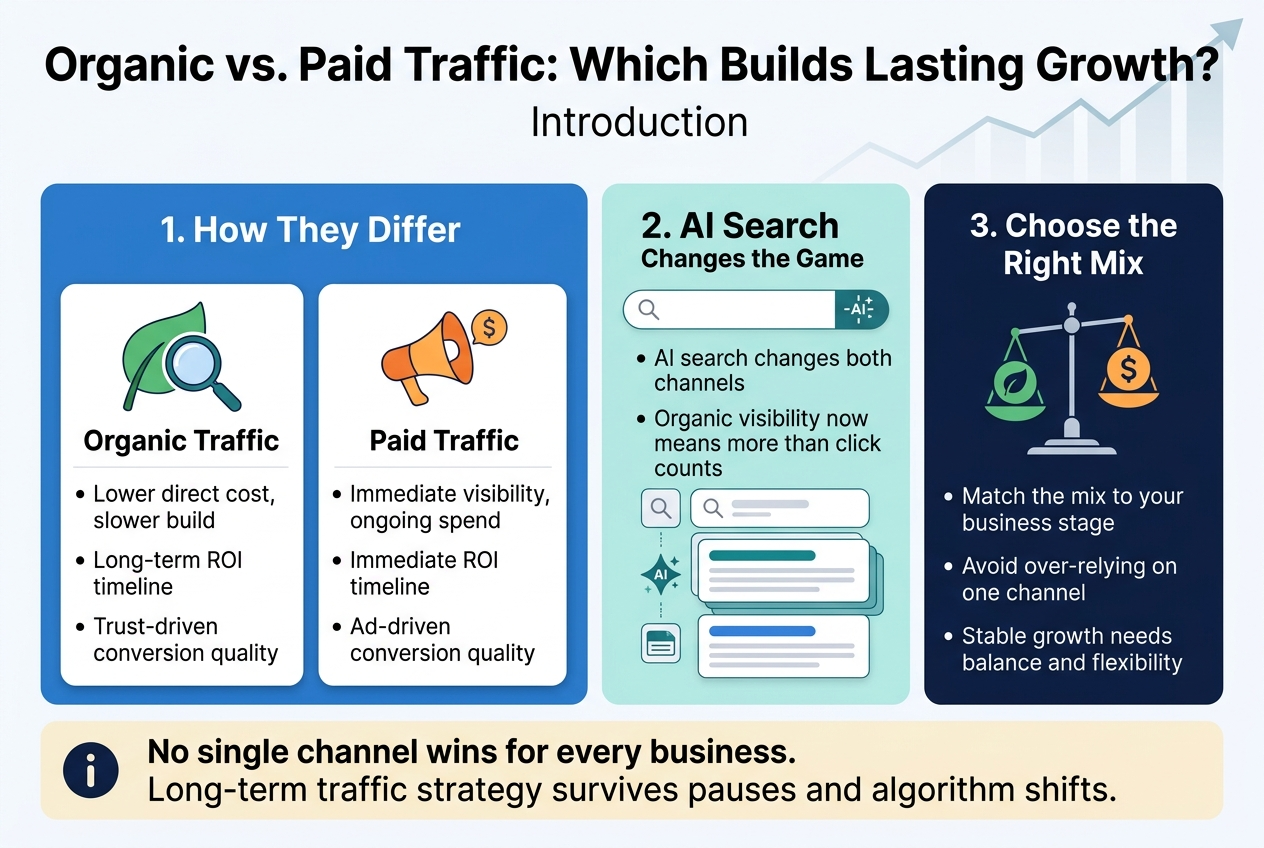
If you’ve ever stared at a rising cost-per-click and wondered whether paid ads are still worth it, you’re not alone. The average CPC on Google Search hit $5.42 in 2026, and that number keeps climbing. So the question of organic vs. paid traffic isn’t just academic — it’s a real budget decision that affects how fast your business grows and how stable that growth actually is.
This guide is for founders, marketing managers, and digital strategists who want a straight answer on where their next dollar should go.
Here’s what we’ll cover:
- How organic and paid traffic actually differ — not just in definition, but in cost structure, ROI timeline, and conversion quality
- What AI search is doing to both channels — and why organic visibility now means more than just click counts
- How to pick the right mix for your business stage without over-relying on one side and paying for it later
No single channel wins for every business. But knowing how each one works — and where each one breaks down — is what separates a long-term traffic strategy from one that stalls the moment a campaign pauses or an algorithm shifts.
Understanding the Core Difference Between Organic and Paid Traffic
How Organic Traffic Reaches Your Site
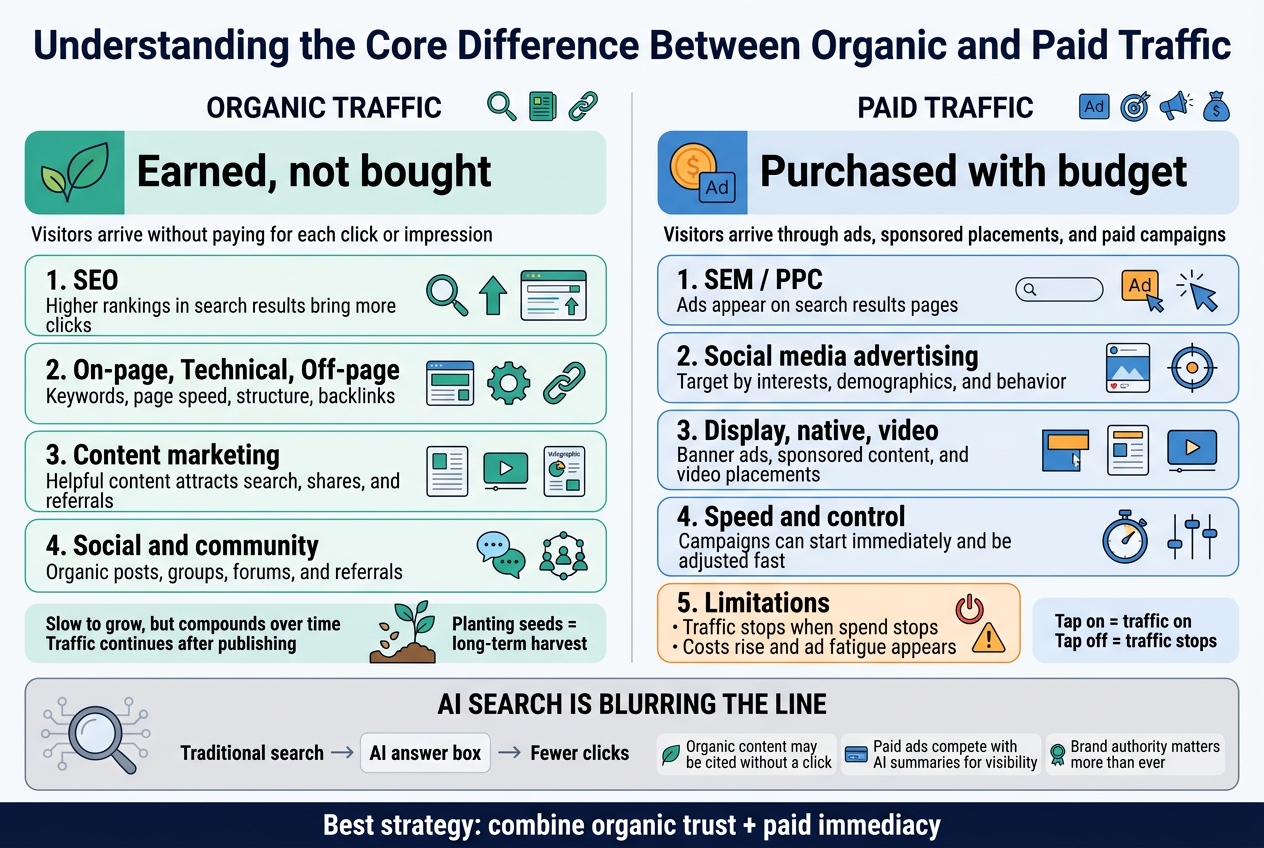
When people talk about organic traffic, they are referring to every visitor who lands on your website without you having to pay for that specific click or impression. These are users who discovered your content naturally — through a search engine results page (SERP), through a social media post you published without boosting it with ad spend, or through a link on another website that chose to reference your content because it was genuinely valuable. The defining characteristic of organic traffic is that it is earned, not bought.
Understanding how organic traffic actually reaches your site requires pulling back the curtain on several interconnected processes that work simultaneously over time. None of them deliver results overnight, but each of them contributes to building a compounding, sustainable stream of visitors that does not evaporate the moment you stop spending money.
The Role of Search Engine Optimization in Driving Organic Visitors
Search engine optimization — commonly referred to as SEO — is the foundational pillar of most organic traffic strategies. At its core, SEO is the practice of optimizing your website and its content so that search engines rank it higher in their results pages when users type in relevant queries.
When someone opens Google, Bing, or any other search engine and types a question or keyword, the search engine’s algorithm crawls through billions of indexed pages to determine which results are most relevant, authoritative, and trustworthy for that specific query. If your content is well-optimized — meaning it addresses the topic comprehensively, uses relevant language naturally, loads quickly, earns links from other credible sites, and provides a strong user experience — the algorithm will reward it with a higher ranking position.
The higher your ranking, the more organic traffic you receive. Studies have consistently shown that the top results on a search engine results page capture the overwhelming majority of clicks, while pages buried on the second or third page receive dramatically less attention. This is why SEO is treated as such a high-priority investment by digital marketers and business owners who are thinking about the long game.
SEO itself encompasses several distinct disciplines that work together:
- On-page SEO: This involves optimizing the content and structure of individual web pages. It includes using relevant keywords naturally throughout your content, crafting compelling title tags and meta descriptions, structuring content with logical heading hierarchies, and ensuring your content genuinely answers the questions your target audience is asking.
- Technical SEO: This refers to the backend elements of your website that affect how search engines crawl and index your content. Page speed, mobile responsiveness, secure HTTPS connections, proper XML sitemaps, and clean site architecture all fall under this umbrella. If your technical foundation is broken, even the best content will struggle to rank.
- Off-page SEO and link building: Search engines treat backlinks — links from external websites pointing to yours — as votes of confidence. When authoritative and relevant websites link to your content, search engines interpret this as a signal that your content is trustworthy and worth ranking. Building these links organically requires creating content that is genuinely worth referencing, developing relationships with other content creators, and sometimes earning media coverage.
The key insight about SEO as a channel for organic traffic is the compounding nature of its returns. A well-optimized piece of content can continue to rank and drive visitors for months or even years after it was originally published. Unlike a paid ad that stops generating clicks the moment your budget runs out, an SEO-driven blog post, guide, or product page keeps working passively. This is precisely what makes organic search traffic such a foundational element of any long-term traffic strategy.
However, it is equally important to be honest about the timeline. SEO is a slow process. Building enough authority and topical relevance to rank competitively for high-value keywords can take anywhere from several months to well over a year, depending on how competitive your industry is and how established your website already is. For businesses that need results immediately, this timeline can feel frustrating — which is one of the central tensions explored throughout this blog post.
Content Marketing as an Organic Traffic Engine
Closely intertwined with SEO is content marketing — the practice of creating valuable, relevant, and consistent content that attracts and retains a clearly defined audience. Blog posts, how-to guides, case studies, research reports, videos, infographics, and podcasts all fall under the content marketing umbrella.
The mechanism through which content marketing drives organic traffic is straightforward: when you publish content that genuinely helps people solve problems, answer questions, or learn something new, search engines surface that content to users who are searching for exactly those answers. Beyond search engines, great content earns shares on social media, gets referenced by other websites, and builds an audience that returns to your site on its own.
Content marketing is not simply about publishing as much content as possible. Quality and relevance are what matter. A single deeply researched, comprehensive guide on a topic your audience cares about can outperform dozens of thin, surface-level articles. The goal is to create content that your target audience genuinely finds useful — content that naturally positions your brand as a trusted authority in your space.
When your content strategy is working correctly, visitors who discover your business through a helpful blog post or guide arrive with a foundational level of trust already established. They found you because you gave them something of value without requiring anything in return upfront. This dynamic — being discovered in a natural, non-interruptive way — is one of the most powerful advantages of organic traffic. It increases the likelihood that those visitors will convert into customers, and it does so through a process that feels authentic rather than promotional.
Social Media and Community Participation as Organic Channels
Organic traffic does not flow exclusively through search engines. Social media platforms represent another significant organic channel, though one that has become increasingly complicated over time.
When you build a genuine following on platforms like Instagram, Facebook, LinkedIn, TikTok, or X (formerly Twitter) and consistently publish non-sponsored content that resonates with your audience, those followers visit your website, share your content with their networks, and generate referral traffic. Participating in relevant online communities — forums, subreddits, industry-specific groups, comment sections — can also drive organic visitors to your site when you contribute genuinely helpful information and naturally reference your content where appropriate.
The organic reach on social media platforms has declined significantly over the past decade as these platforms have increasingly prioritized paid content in their algorithms. However, organic social media still plays a meaningful role in driving traffic, particularly for brands that have invested in building authentic communities and for content that naturally generates high engagement.
Why Organic Traffic Takes Time — and Why That Time Is Worth It
One of the most important things to understand about organic traffic is that it is inherently a medium-to-long-term investment. The slower pace is not a flaw in the strategy — it is actually what creates the durability and trust that make organic traffic so valuable.
Because organic traffic is earned through consistent effort, valuable content, and genuine authority-building, it creates a compounding effect over time. Each new piece of content you publish, each backlink you earn, and each improvement you make to your site’s technical foundation adds to a cumulative base that keeps generating returns. A business that has invested seriously in SEO and content marketing for two or three years has built a traffic asset that is extraordinarily difficult for competitors to replicate quickly — and that continues to deliver value without requiring ongoing ad spend.
This is the garden metaphor that resonates so well in this context: planting seeds is cheaper and takes longer, but the results last longer. Organic traffic is the seeds. The investment is time, expertise, and consistent effort rather than a monthly advertising budget — and the harvest, when it comes, is a steady stream of visitors who found you naturally and trust you because of it.
How Paid Traffic Reaches Your Site
Where organic traffic earns its way onto your site through quality and authority, paid traffic purchases its way there through strategic financial investment. Paid traffic is the practice of paying advertising platforms to display your ads, listings, or sponsored content to targeted audiences, driving those users directly to your website, landing page, or product page.
The defining characteristic of paid traffic is immediacy. You set up a campaign, fund it with a budget, define your targeting parameters, and your ads start appearing in front of potential visitors almost instantly. As soon as your campaigns are live, you can start seeing measurable increases in website traffic. This speed advantage is the single most compelling differentiator of paid traffic compared to organic, and it is the primary reason why so many businesses — particularly those in their early stages or those launching time-sensitive promotions — rely heavily on paid channels.
The Major Paid Traffic Channels
Paid traffic is not a monolithic category. It encompasses a wide variety of platforms and ad formats, each with its own strengths, targeting capabilities, and best-use scenarios.
Search Engine Marketing (SEM)
Search engine marketing, often referred to as pay-per-click (PPC) advertising, involves paying to have your ads appear on search engine results pages. Google Ads is the dominant player in this space, allowing advertisers to bid on specific keywords so that their ads appear at the top or bottom of the search results when users search for those terms.
The core appeal of SEM is intent targeting. When someone searches for “best project management software for small teams,” they are actively looking for a solution. By placing an ad in front of them at that exact moment of high intent, you are reaching a prospect who is already in the market for what you offer. This makes SEM one of the highest-converting paid traffic channels available, particularly for businesses with products or services that people actively search for.
The cost of SEM is typically measured on a cost-per-click (CPC) basis — you pay each time someone clicks on your ad. CPC rates vary enormously depending on the competitiveness of the keywords you are targeting. Highly competitive keywords in lucrative industries can cost tens of dollars per click, which means that SEM requires careful management and optimization to remain profitable.
Social Media Advertising
Social media platforms — including Facebook, Instagram, LinkedIn, TikTok, Pinterest, and others — offer powerful advertising options that allow brands to reach highly specific audience segments based on demographics, interests, behaviors, and more.
Unlike SEM, which targets users based on what they are actively searching for, social media advertising targets users based on who they are and what they are interested in. This makes it particularly effective for building brand awareness, reaching audiences who may not yet know they need your product, and retargeting users who have already visited your website.
Facebook and Instagram Ads, managed through Meta’s advertising platform, are especially well-known for their sophisticated audience targeting capabilities. LinkedIn Ads are often the preferred choice for B2B advertisers trying to reach professionals based on their job titles, industries, and company sizes.
Display Advertising
Display ads are visually engaging banner, image, or video ads that appear on websites across ad networks. Google’s Display Network, for example, allows advertisers to place ads across millions of websites that have agreed to host advertising. Display advertising is particularly effective for brand awareness and retargeting — showing ads to users who have previously visited your site but did not convert.
Native Advertising
Native ads are designed to blend in with the surrounding editorial content of the platform on which they appear. They look and feel like organic content — an article recommendation at the bottom of a news page, for instance — but are actually paid placements. Native advertising can be highly effective because it delivers promotional messages in a less interruptive format.
Video Advertising
Video ads on platforms like YouTube allow advertisers to capture attention through dynamic, visually rich formats. Pre-roll ads, mid-roll ads, and display ads within YouTube’s interface give brands multiple ways to engage audiences. Video advertising is particularly powerful for storytelling, brand-building, and demonstrating products or services in action.
CPA Networks and Programmatic Traffic
Beyond the major platforms, there are also cost-per-action (CPA) networks and programmatic advertising platforms that allow advertisers to purchase traffic at scale across a broad range of websites and audiences. These platforms often offer sophisticated tools for campaign management, targeting, and optimization, making them popular with performance marketers and affiliate marketers who need to drive high volumes of targeted traffic efficiently.
The Core Advantages of Paid Traffic
Understanding how paid traffic reaches your site also means understanding why so many businesses invest heavily in it, despite the ongoing cost. The advantages are real and significant.
Speed and Immediacy
As noted, paid traffic delivers results almost immediately. From campaign launch to first visitor, the timeline can be measured in hours rather than months. For a business launching a new product, promoting a time-sensitive offer, or entering a new market, this speed is invaluable. There is simply no organic equivalent that can match the immediacy of a well-funded paid campaign.
Precise Targeting and Control
Paid advertising platforms offer extraordinarily sophisticated targeting options. You can define your audience by age, gender, location, income level, interests, online behaviors, device type, time of day, and much more. This level of precision means you are not broadcasting your message to a general audience and hoping the right people see it — you are surgically placing your ads in front of the specific individuals who are most likely to be interested in what you offer.
You also have direct control over your budget, your messaging, and your creative assets. You can run A/B tests on different ad headlines, images, and calls to action to rapidly identify what resonates best with your audience. This ability to test, measure, and optimize in real time gives paid traffic a measurability advantage that organic channels often cannot match.
Strategic Placement
Paid ads are placed in the most visible, high-traffic positions on the platforms where you advertise. At the top of search results, in prominent positions within social media feeds, and on high-traffic websites across the internet, paid placements are designed for maximum visibility. This strategic positioning creates immediate exposure that can take years to achieve organically.
Scalability
Once you have identified a paid traffic campaign that is generating a positive return on ad spend (ROAS), you can scale it by increasing your budget. This direct relationship between investment and output is one of the most appealing aspects of paid traffic for growth-oriented businesses. With organic traffic, scaling requires more content, more link building, and more time — a slower process by nature.
The Limitations and Risks of Paid Traffic
No discussion of how paid traffic reaches your site would be complete without acknowledging its fundamental limitations, because these limitations have direct implications for your long-term growth strategy.
The Tap-Off Problem
The most critical limitation of paid traffic is its impermanence. The moment you stop paying for ads — whether because your budget runs out, your campaigns become unprofitable, or you decide to redirect resources elsewhere — the traffic stops. Unlike organic traffic, which continues to flow passively over time, paid traffic is entirely dependent on continuous financial investment. There is no accumulation of value over time; each campaign cycle must be funded independently.
This creates a significant business risk: if your entire traffic strategy depends on paid advertising, you are permanently dependent on maintaining your ad spend. Any disruption to your budget — economic downturns, rising ad costs, competitive bidding pressure — can rapidly erode your traffic and revenue.
Rising Costs and Ad Fatigue
The cost of paid advertising has increased significantly across major platforms over the past decade. As more businesses compete for attention on Google, Facebook, and other platforms, the auction-based pricing models that govern these platforms drive up costs. Campaigns that were profitable at lower cost-per-click rates may become marginal or even unprofitable as competition intensifies.
Additionally, users experience ad fatigue — after seeing the same ad multiple times, they begin to ignore or actively avoid it. This means that paid campaigns require constant creative refreshes and ongoing optimization to maintain performance, adding to both the complexity and the cost of running paid traffic effectively.
Credibility and Trust Challenges
Many users have become increasingly skeptical of advertising. They recognize paid ads for what they are and sometimes actively distrust the results or messaging they see in sponsored placements. This skepticism can reduce click-through rates and conversion rates compared to what the same business might achieve through organic channels, where users discover them through a more trust-neutral process.
How AI Search Is Blurring the Line Between Both Channels
With a clear picture of how organic and paid traffic each reach your site established, it is worth examining a development that is actively reshaping both channels simultaneously — and creating a genuinely new landscape that neither category fully anticipated. The rapid rise of AI-powered search is not simply a tweak to existing search mechanics; it represents a structural shift in how users interact with search engines, and by extension, how both organic and paid traffic are generated and valued.
This is perhaps the most forward-looking dimension of the organic vs. paid traffic conversation, and understanding it is essential for any business thinking seriously about building sustainable traffic growth in the years ahead.
What AI Search Actually Means for How People Find Information
Traditional search engine mechanics follow a well-understood pattern: a user types a query, the search engine returns a list of ranked links, and the user clicks through to websites that contain the information they are looking for. This click-based model is the foundation upon which both SEO (organic) and SEM (paid) have been built.
AI-powered search changes this dynamic in a fundamental way. Instead of simply returning a list of links, AI search systems — most prominently represented by Google’s Search Generative Experience (SGE) and similar features being rolled out across major search engines — generate direct, synthesized answers to user queries. These AI-generated responses pull information from multiple sources across the web and present a comprehensive answer directly on the search results page, often without requiring the user to click through to any individual website at all.
This represents a significant challenge to the traditional organic traffic model. If a user can get a complete, accurate answer to their question directly within the search results page, the incentive to click through to the source websites that informed that answer is dramatically reduced. This phenomenon — sometimes called “zero-click searches” — is not new, but AI search dramatically accelerates and expands it.
For businesses that have invested heavily in SEO as their primary organic traffic strategy, the implications are profound. Content that ranks well organically may still be used to inform AI-generated answers — contributing to the AI’s response — without generating the click-through traffic that organic rankings traditionally delivered. The value of the organic ranking, in this scenario, shifts from driving direct traffic to influencing the AI’s answers and contributing to brand visibility and authority signals.
How AI Search Is Reshaping the Organic Traffic Landscape
The rise of AI search creates a set of new strategic questions for anyone building an organic traffic strategy.
From Click-Through Traffic to Answer Visibility
In an AI search environment, the goal of content marketing and SEO shifts in a meaningful way. It is no longer sufficient to simply rank for a keyword and expect traffic to flow from that ranking. The new challenge is to create content that is authoritative, trustworthy, and comprehensive enough that AI search systems will draw from it when generating their synthesized answers — and that when users do choose to click through for more depth, it is your site they land on.
This shifts the emphasis of SEO away from pure keyword optimization toward demonstrated expertise, authoritativeness, and trustworthiness — qualities that search engines have been increasingly prioritizing even before the AI era through frameworks like Google’s E-E-A-T (Experience, Expertise, Authoritativeness, Trustworthiness). In an AI search world, these qualities become even more important because AI systems are likely to favor content from sources that demonstrate genuine depth of knowledge over content that is merely well-optimized for search algorithms.
The Changing Value of Long-Form, In-Depth Content
One of the strategic responses to AI search’s impact on organic traffic is to invest in content that goes beyond what an AI can easily synthesize into a quick answer. Deeply researched, original content that offers unique insights, proprietary data, first-hand experience, and nuanced perspective is harder for AI systems to fully replicate in a brief summary. Users who encounter a surface-level AI-generated answer but want genuine depth, original research, or specialized expertise are still motivated to click through to the source.
This means that the highest-value organic content in an AI search environment is content that cannot be easily commoditized into a quick answer — content that delivers something genuinely unique, whether that is original research, expert commentary, interactive tools, detailed how-to guidance, or community-driven insights.
Trust and Authority Signals Become Even More Critical
For organic traffic strategies, the AI search era reinforces the importance of building genuine domain authority and brand credibility. AI systems are more likely to surface content from established, trusted sources, which means that investments in link building, reputation management, and consistent expert content creation remain as important as ever — possibly more so.
Businesses that have built strong organic authority over time are better positioned to have their content referenced and surfaced by AI search systems, even if the traffic model is shifting. This is why the long-term investment in organic traffic remains strategically valuable even as the mechanics of how that value is realized evolve.
How AI Search Is Reshaping the Paid Traffic Landscape
The impact of AI search on paid traffic is equally significant, though it manifests differently. As AI fundamentally alters how search results pages are structured, the placement and visibility of paid ads within those pages is changing too.
Ad Placement in AI-Driven Search Environments
As AI-generated answer boxes take up more prominent real estate at the top of search results pages, the traditional positions for paid search ads become more crowded and competitive. Advertisers bidding for visibility in an AI search environment must navigate a landscape where organic content, AI-generated summaries, and paid placements are all competing for a user’s attention in a more complex layout than the traditional ten blue links.
This competitive pressure on ad placement drives up costs — a dynamic that compounds the already rising cost trends in paid search advertising. Advertisers who relied on predictable positioning and click-through rates from paid search will need to adapt their expectations and bidding strategies as AI search evolves.
The Opportunity in AI-Adjacent Paid Advertising
At the same time, AI search creates new opportunities for paid advertising that are worth recognizing. As AI systems generate answers, they need to source information from somewhere — and the businesses that are most visible, most authoritative, and most consistently present across both organic and paid channels are more likely to be surfaced, referenced, and clicked through by users who want to go deeper than the AI summary.
Paid advertising can accelerate the brand visibility and recognition signals that make a business more likely to be trusted and chosen by users, even in an AI-mediated search environment. A user who has seen a brand’s paid ads across multiple platforms may be more inclined to click through to that brand’s website when it appears in an AI-generated search response, because the brand already has some level of recognition and trust established.
AI Is Also Changing Paid Advertising Tools and Targeting
It is worth noting that AI is not just reshaping the search environment where paid ads appear — it is also transforming how paid advertising campaigns are built, managed, and optimized. Google’s Performance Max campaigns, Meta’s Advantage+ shopping campaigns, and similar AI-driven campaign formats use machine learning to automate audience targeting, bidding, ad creative selection, and placement across channels. These tools are making paid advertising simultaneously more accessible and more complex, as the algorithm takes on more of the tactical decision-making that marketers previously managed manually.
For advertisers, this means that the skills required to run effective paid campaigns are shifting — from granular tactical management toward higher-level strategic input, creative quality, and audience signal optimization. Businesses that understand how to work effectively with AI-driven advertising tools will have a significant advantage in the paid traffic landscape going forward.
The Blurring Line: When Organic and Paid No Longer Have Clean Boundaries
What the rise of AI search most fundamentally reveals is that the traditional clean boundary between organic and paid traffic is becoming increasingly blurred — and that understanding this blurring is essential for building a traffic strategy that will hold up in the years ahead.
Consider the following scenarios where the line becomes unclear:
| Scenario | Traditional Classification | AI Search Era Reality |
|---|---|---|
| A brand’s blog post is referenced in an AI-generated answer | Organic traffic | Brand visibility without a direct click — neither fully organic nor paid |
| A paid ad appears alongside an AI summary box | Paid traffic | Ad placement and click dynamics are altered by the new search layout |
| A user asks an AI chatbot for a product recommendation | Neither organic nor paid | Brand authority and content quality influence AI recommendations outside traditional search |
| A business uses AI tools to generate paid ad copy | Paid traffic | The line between content creation (organic) and ad creation (paid) blurs at the production level |
| An AI search system cites a piece of content as a source | Organic reference | Traffic may not materialize from the citation, changing the value calculation of organic rankings |
These scenarios illustrate a deeper truth: as AI reshapes the digital landscape, the frameworks we have used to separate organic and paid traffic are becoming less useful as rigid categories and more useful as general principles within a more fluid, interconnected ecosystem.
What This Means for How You Think About Traffic Channels
The emergence of AI search does not make organic or paid traffic less important — it makes the relationship between them more important than ever, and it changes the specific tactics and metrics that matter most within each channel.
For organic traffic, the focus must shift toward building genuine authority, producing content with unique depth and original value, and optimizing for trust signals that matter to both human readers and AI systems. The goal of organic traffic in an AI search era is not simply to rank for keywords but to become the kind of recognized, authoritative source that AI systems surface and that users actively choose to explore beyond the AI-generated summary.
For paid traffic, the focus must increasingly be on brand visibility, audience-level targeting, and creative quality — rather than simply bidding for keyword positions in a static search results layout. As AI changes the search landscape, paid advertisers will need to think across multiple channels and formats to maintain the visibility that search alone used to reliably deliver.
And for businesses thinking about the balance between organic and paid traffic, the AI search era reinforces a conclusion that the reference sources consistently emphasize: the most effective approach combines both channels strategically, leveraging the immediacy and targeting precision of paid traffic alongside the trust, authority, and compounding returns of organic traffic.
The garden metaphor holds, but it needs updating for the AI era. You are still planting seeds (organic) and buying plants (paid) — but the garden itself is changing. The soil is different, the climate is shifting, and the tools you use to tend it are becoming smarter. The fundamental principles of what makes growth sustainable — consistent effort, genuine quality, and strategic thinking — remain as true as they have ever been. What changes is the specific application of those principles in an environment where AI is reshaping how information flows between creators and consumers.
Navigating the Organic vs. Paid Dynamic in an AI-Influenced World
For businesses currently assessing their traffic strategies in light of these AI-driven shifts, a few strategic considerations emerge directly from this analysis.
First, the organic content you create today needs to be built with more than search engine rankings in mind. Content that is comprehensive, credible, and genuinely useful is more likely to be surfaced by AI search systems, more likely to earn trust from users who encounter AI-generated summaries and want to go deeper, and more likely to build the brand authority that makes paid advertising more effective through recognition and trust effects. Organic and paid are increasingly mutually reinforcing, not simply parallel.
Second, paid traffic strategies need to account for the changing geometry of search results pages. As AI summaries take up more space above the fold, the premium on paid ad placements becomes more competitive. Diversifying paid traffic across multiple channels — search, social, display, native, video — reduces dependence on any single placement environment and builds more resilient reach.
Third, brand-building — which traditionally sits somewhat ambiguously between organic and paid — becomes more important in an AI search era than it was in a pure link-based search environment. Users who recognize and trust your brand are more likely to click through to your site when it appears in an AI-generated context, more likely to engage with your paid ads, and more likely to return directly without requiring either organic or paid acquisition every time.
Finally, the metrics you use to evaluate the success of your organic traffic efforts may need to evolve. If AI search means that some users consume your content’s insights through an AI-generated summary without clicking through to your site, then raw traffic numbers will increasingly understate the brand visibility and influence value that your organic content is generating. Measuring brand awareness, share of voice in AI-generated answers, and the quality of traffic rather than simply its volume will become more important dimensions of organic traffic evaluation.
Now that we have covered how organic traffic reaches your site through earned channels like SEO, content marketing, and social participation — and how paid traffic reaches your site through the immediate, targeted, and budget-driven mechanisms of search ads, social advertising, display, and other paid formats — and with the emerging reality of how AI search is actively blurring the boundaries between both channels clearly mapped out, the stage is set to compare these channels across the specific factors that matter most for your business decisions. With this in mind, next, we will see how organic and paid traffic stack up across five key performance dimensions that directly influence which strategy is right for your situation.
Comparing Organic vs. Paid Traffic Across Five Key Factors
A. Cost Structure: Upfront Investment vs. Ongoing Spend
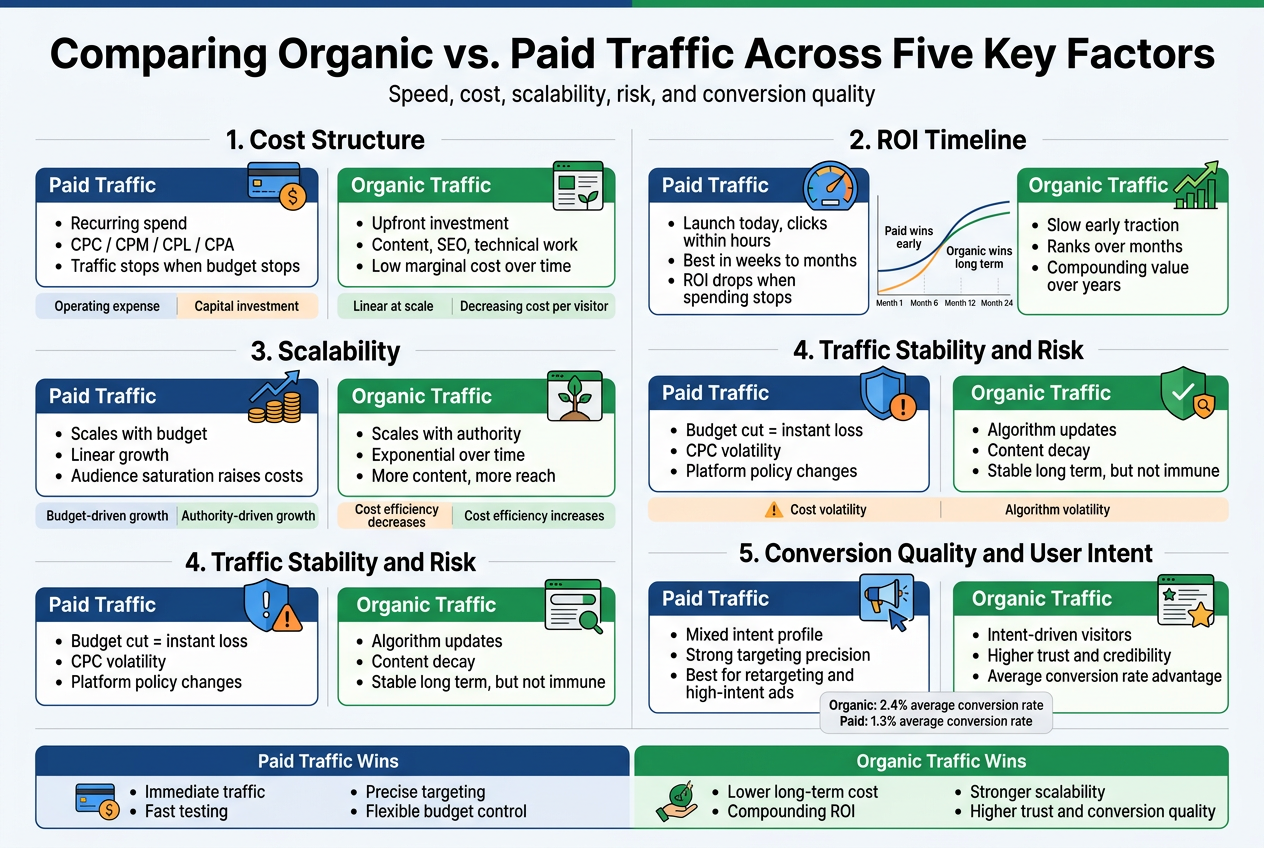
When businesses sit down to choose between organic vs paid traffic, the first question that almost always surfaces is a simple one: what does it actually cost? But the answer is far from simple, because the two channels operate on fundamentally different financial models — and understanding those models in detail is what separates teams that build smart, sustainable strategies from those that burn through budgets without a lasting return.
How Paid Traffic Charges You
Paid traffic operates on a direct spend model. Every visit, every impression, and every conversion comes with a price tag attached to it. Whether you are running Google Ads search campaigns, Meta paid social placements, LinkedIn sponsored content, display ads across publisher networks, or YouTube pre-roll video ads, the billing mechanism is consistent: you pay to play, and the moment you stop paying, the traffic stops arriving.
The most common pricing structures in paid traffic include:
- Cost per click (CPC): You are charged each time a user clicks your ad, regardless of whether they convert.
- Cost per thousand impressions (CPM): You pay for visibility, not engagement, making this more suitable for brand awareness campaigns.
- Cost per lead (CPL) or cost per acquisition (CPA): You pay only when a user completes a defined action, such as filling out a form or making a purchase.
In competitive industries — think legal services, financial products, SaaS, insurance, or healthcare — the cost per click can be staggering. High-competition commercial keywords have CPCs that make customer acquisition expensive at scale. As you push for more volume, you typically need to either bid higher, expand your targeting, or accept lower-quality placements. All three paths carry cost implications.
The recurring nature of this spend is what makes paid traffic feel like renting rather than owning. Your ad budget is an operating expense, similar to paying rent on a retail storefront. The customers walk in while you are open and paying for the lease. Once the budget runs dry or the campaign is paused, the storefront goes dark.
This does not make paid traffic a poor choice — far from it. But it does mean that the cost structure requires ongoing financial commitment, and the total investment needed scales directly and linearly with the volume of traffic you want to drive. To double your paid traffic, you roughly need to double your budget.
How Organic Traffic Charges You
Organic traffic behaves entirely differently. There is no cost per click, no impression fee, and no payment made to a platform each time a visitor lands on your page from an unpaid search result. However, the idea that organic traffic is “free” is one of the most persistent and damaging misconceptions in digital marketing.
Organic traffic is not free. It requires upfront investment in:
- Content creation: Writing high-quality blog posts, guides, landing pages, comparison articles, and other content assets takes time and skilled labor.
- SEO tools and technology: Platforms for keyword research, technical audits, backlink analysis, and rank tracking carry subscription costs.
- On-page SEO optimization: Structuring titles, headings, internal links, schema markup, and metadata correctly requires expertise.
- Off-page SEO: Building links and authority from reputable external sources involves outreach, relationship-building, and sometimes investment in digital PR or content partnerships.
- Technical SEO maintenance: Ensuring your site loads quickly, functions correctly on mobile, resolves crawl errors, and maintains a clean architecture is ongoing technical work.
The key difference is that these costs are investments rather than operational expenses. Once a piece of content ranks on page one of search results, it can drive traffic for months or even years without any additional spend per visitor. The upfront investment depreciates over time in your favor, not against it.
A simplified way to think about the two cost models:
| Cost Dimension | Paid Traffic | Organic Traffic |
|---|---|---|
| Cost per visit | Direct, recurring | Indirect, one-time upfront |
| What stops traffic | Budget pause | Algorithm shift or content decay |
| Cost at scale | Linear increase | Decreasing cost per visitor over time |
| Primary expense type | Operating expense | Capital investment |
| Financial risk | Budget volatility | Time and resource investment |
| Ownership of assets | Platform-dependent | Owned by your business |
The Cost Gap Widens Over Time
One of the most important points to understand when comparing the cost structures of organic and paid traffic is what happens to the cost efficiency of each channel as time passes.
With paid traffic, costs tend to rise over time, not fall. Competition in ad auctions intensifies as more advertisers enter the market. Platform algorithm changes can affect quality scores and ad relevance, pushing up CPCs even when your targeting remains consistent. Ad fatigue sets in, forcing you to refresh creative more frequently, which adds production costs. What you paid per lead in month one of a campaign may look very different from what you are paying in month eighteen.
With organic traffic, the opposite dynamic often plays out for teams that invest consistently. Early on, the cost per visitor is high relative to the actual traffic received, because you are investing in content and infrastructure before most of it has ranked. But as pages begin to rank, as your domain authority builds, and as your content library compounds, the effective cost per organic visitor decreases steadily. A piece of content that cost your team forty hours to produce in the first month might generate thousands of visits over the next two years, dramatically reducing its average cost per visit over its lifetime.
Over time, organic acquisition costs typically decrease for SEO-driven channels, while paid acquisition costs often rise as competition intensifies and campaigns scale. This long-term cost trajectory is one of the most compelling financial arguments for investing in organic traffic, particularly for businesses thinking in multi-year horizons rather than quarterly sprints.
Budget Flexibility and Risk Management
One practical advantage of paid traffic is that its cost structure offers granular control and immediate flexibility. You can set daily budgets, pause campaigns instantly, shift spend between channels in real time, and reduce or increase investment based on business conditions. If a campaign is not performing, you can stop it without having wasted months of work.
Organic traffic does not offer this kind of financial flexibility. The content and SEO work you have done cannot be “paused.” The investment has already been made. If a strategy is not working, course-correcting takes time, and the costs of that early effort do not come back to you if the approach needs to change significantly.
However, this apparent inflexibility comes with a corresponding benefit: unlike paid campaigns, the assets you build through organic SEO are owned by your business. A well-ranking article, a high-authority backlink profile, and an established domain presence represent genuine intellectual and strategic assets. They persist even when you reduce your content budget temporarily, which gives organic traffic a structural resilience that paid traffic can never replicate.
With all of this in mind, next we will examine how these different cost structures translate into very different return-on-investment timelines — because cost alone does not tell the full story of which channel builds more value.
B. ROI Timeline: Immediate Payoff vs. Compounding Value
Perhaps no factor creates more confusion in the organic vs paid traffic debate than the difference in how and when each channel delivers returns. Many businesses have made costly strategic mistakes by applying the wrong timeline expectations to the wrong channel. Understanding the precise way ROI builds in each model is critical for making informed decisions and setting realistic performance benchmarks.
The Paid Traffic ROI Curve
Paid traffic’s defining characteristic is speed. Launch a Google Ads campaign today, and you can receive clicks within hours. Within days, you have data on which keywords are converting, which ad copy is resonating, and which landing pages are underperforming. Within weeks, you have enough information to run meaningful A/B tests, refine your bidding strategy, and optimize your paid media strategy across the funnel.
This speed is genuinely powerful, and in the right context — a product launch, a seasonal promotion, a webinar campaign, a limited-time offer — it is difficult to overstate how valuable immediate traffic can be. When you need leads this month, for a specific campaign, at a defined target volume, paid traffic delivers in a way that organic traffic simply cannot match in the short term.
The ROI curve for paid traffic tends to look like this:
- Days 1–7: Campaigns go live. Initial clicks arrive. Spend begins immediately.
- Weeks 1–4: Early data on CTR, CPC, conversion rate, and CPA becomes available. First optimizations are made.
- Months 1–3: Campaign performance stabilizes. ROI becomes measurable and relatively predictable. This is typically the period where paid campaigns perform best relative to their cost, assuming good targeting and creative.
- Months 3–12+: ROI can plateau or decline as ad fatigue sets in, competition intensifies, and creative refreshes become necessary. Cost per acquisition often rises during this phase.
The critical limitation of this curve is what happens at the end of it. When spending stops, ROI drops to zero almost immediately. There is no residual return, no compounding effect, and no legacy value. The investment made in month three does not contribute to results in month nine once the campaign is off. Every month requires its own budget to generate its own traffic, and the relationship between spend and return remains largely linear throughout.
This is what the reference describes when it says paid traffic offers a “moderate” long-term ROI that “stops when spending stops.” The returns are real, often significant, but entirely contingent on continuous financial input.
The Organic Traffic ROI Curve
The ROI trajectory for organic traffic looks almost inverted compared to paid — and this is both its greatest weakness in the short term and its greatest strength over a longer horizon.
In the early months, organic traffic produces almost no visible return. Content gets published, indexed, and begins slowly building authority and topical relevance. Rankings for most competitive keywords take three to nine months or more to establish. During this phase, the investment is going out and very little is coming back, which makes organic SEO feel frustratingly slow, especially for businesses under pressure to show quick results.
A realistic organic traffic ROI timeline looks like this:
- Months 1–3: Content published and indexed. Little to no ranking visibility on competitive terms. Some early traction on long-tail, low-competition queries.
- Months 3–6: Rankings begin to appear, particularly for less competitive and long-tail keywords. Trickle of organic traffic starts. Total ROI still low relative to investment.
- Months 6–12: Strong SEO campaigns begin compounding. Traffic from multiple articles and pages stacks together. More keywords ranking, more pages attracting visits. ROI starts to become visible and meaningful.
- Year 1–2+: The compounding effect accelerates. Authority built from earlier content and link-building supports faster ranking of new content. Pages that ranked at position eight begin climbing to position three or four. Organic traffic often reduces reliance on paid spend at this stage.
- Year 2–3+: Mature organic programs generate significant traffic at a very low marginal cost per visit. The ROI from original content investments continues to compound as those pages maintain or improve their rankings.
The compounding nature of organic traffic is what makes its long-term ROI “very high” as described in the reference material. Each piece of well-optimized content that ranks is not just a single asset — it contributes to your domain’s overall authority, which in turn makes every subsequent piece of content easier to rank. The system builds on itself in a way that paid traffic does not.
Visualizing the Crossover Point
When both channels are plotted on a timeline, an important pattern emerges: there is a crossover point where the cumulative ROI of organic traffic surpasses that of paid traffic. This crossover typically occurs somewhere in the six-to-twelve-month range for well-executed organic programs, though it varies widely depending on industry competition, content quality, domain authority, and budget allocation.
| Timeline | Paid Traffic ROI | Organic Traffic ROI |
|---|---|---|
| Month 1 | High relative return | Very low, pre-ranking |
| Month 3 | Solid, measurable | Starting to trickle |
| Month 6 | Plateauing | Accelerating |
| Month 12 | Requires fresh budget | Compounding strongly |
| Month 24 | Linear to spend | Significantly outpacing initial investment |
| Month 36+ | Constant re-investment required | Generating traffic at minimal marginal cost |
Before the crossover point, paid traffic typically delivers better returns per dollar spent. After it, organic traffic’s compounding advantage becomes increasingly difficult for paid traffic to match on a cost-efficiency basis — assuming the organic program has been executed well.
Why the Compounding Effect Matters So Much
The compounding value of organic traffic deserves specific examination, because it is the mechanism behind the long-term ROI advantage, not just a vague benefit.
When a high-quality guide or article achieves a top-ten ranking for a target keyword, several compounding effects begin to stack:
- Traffic compounds: As the page moves from position eight to position three, click-through rates increase non-linearly. The difference in clicks between position eight and position three is often two to five times, not incremental.
- Authority compounds: As the page accumulates backlinks from other sites referencing it, the domain authority of your entire website increases, which helps all other pages on your site rank more easily. A single high-performing piece of content lifts the entire ship.
- Topical relevance compounds: Search engines reward sites that demonstrate deep expertise in a topic cluster. Publishing interconnected articles around related keywords builds topical authority, which means your tenth article on a subject is generally easier to rank than your first.
- Content compounds across intent stages: As your content library grows, you capture users at different stages of the buyer journey — awareness, consideration, and decision. Each new piece of content adds another entry point into your ecosystem, compounding the total addressable organic audience.
None of these compounding dynamics exist in paid traffic. A paid ad does not become easier or cheaper to run because you have run other ads. A click from an ad does not improve your ability to earn future clicks. The system does not self-reinforce. This is the fundamental structural difference in the ROI timelines of the two channels.
Matching Timeline Expectations to Business Goals
The ROI timeline comparison makes clear that the “right” channel depends heavily on your business’s current needs and planning horizon. If your goal is to show lead volume this quarter for a sales-critical campaign, expecting organic traffic to deliver on that timeline sets you up for failure and frustration. If your goal is to reduce customer acquisition costs over the next two to three years and build a defensible traffic asset, expecting paid ads to accomplish that goal equally well is equally misguided.
Sophisticated businesses use these timeline differences intentionally: paid traffic covers near-term demand while organic infrastructure is being built, and then organic traffic increasingly carries more of the load as it matures — often allowing the business to reinvest a portion of what was spent on ads into content and SEO instead.
Now that we have covered cost structure and ROI timelines in depth, next we will examine how each channel scales — and why the mechanics of scaling are so different between the two models.
C. Scalability: Budget-Driven Growth vs. Authority-Driven Growth
Scalability is one of the most practically important factors in any long-term marketing strategy, and it is an area where organic and paid traffic diverge dramatically in their underlying mechanics. Understanding how each channel scales — and what determines the ceiling of that growth — helps businesses set realistic growth targets and avoid scaling traps that have derailed many well-funded marketing programs.
How Paid Traffic Scales
Paid traffic scales with budget. This relationship is direct, predictable, and, in many ways, comfortingly simple. If you spend one thousand dollars per month and generate one hundred leads, doubling your budget to two thousand dollars should, in theory, generate approximately two hundred leads. The linear relationship between spend and volume is one of paid traffic’s most attractive qualities for growth teams that need to model customer acquisition costs with precision.
In practice, this linearity holds reasonably well within certain budget and market boundaries. But as paid campaigns scale beyond those boundaries, efficiency challenges emerge:
- Audience saturation: As you target a defined audience repeatedly, the same users see your ads multiple times. Ad fatigue sets in, click-through rates decline, and you must refresh creative more frequently to maintain performance. This adds both cost and operational complexity.
- Keyword auction competition: The most valuable commercial keywords attract the most competitive bidding. As you try to scale spend on these terms, you inevitably encounter diminishing returns as CPC rises.
- Audience expansion trade-offs: To spend more, you often need to broaden your targeting. But broader targeting typically reaches lower-intent users, which can reduce conversion rates even as raw traffic volume increases.
- Platform concentration risk: Scaling paid traffic often means deepening dependence on one or two platforms — Google and Meta being the most common. This concentration creates vulnerability to platform policy changes, algorithm updates, and auction dynamics outside your control.
The scalability of paid traffic is therefore better described as linear but efficiency-constrained. You can scale volume by increasing spend, but the efficiency of that spend typically decreases as volume grows, meaning the cost per acquisition usually rises at scale.
How Organic Traffic Scales
Organic traffic scales through authority, not budget. This is a fundamentally different growth mechanic, and it is what gives organic traffic its exponential potential — though also what makes it harder to accelerate artificially.
The variables that determine how far and how fast organic traffic scales include:
- Domain authority and trust: Sites with strong backlink profiles and established domain authority can rank new content faster and for more competitive keywords. Authority compounds over time, meaning the potential ceiling for organic traffic scales as the domain itself becomes more authoritative.
- Content volume and topical depth: The more comprehensive your coverage of a topic cluster, the more keywords you capture across the full intent spectrum. A site with fifty well-optimized articles on a subject occupies far more search real estate than a site with five.
- Content quality and user engagement: Pages that earn high engagement signals — time on page, low bounce rate, return visits — tend to perform better in rankings over time, creating a positive feedback loop.
- Technical SEO foundations: A technically sound site that loads quickly, has a clean architecture, and is easy for search engines to crawl provides the infrastructure for organic traffic to scale efficiently.
The scaling curve for organic traffic is often described as exponential rather than linear. In the early stages, growth is slow and the relationship between investment and traffic is inefficient. But as authority accumulates and content compounds, the growth rate tends to accelerate — and importantly, the marginal cost of each additional visitor decreases rather than increases.
A comparison of scaling dynamics:
| Scaling Factor | Paid Traffic | Organic Traffic |
|---|---|---|
| Primary growth lever | Budget increase | Content and authority growth |
| Scaling curve shape | Linear | Exponential over time |
| Cost efficiency at scale | Decreasing | Increasing |
| Theoretical growth ceiling | Budget ceiling | Authority and market ceiling |
| Speed of scaling | Immediate | Gradual, cumulative |
| Reversibility | Instantly reversible | Not immediately reversible |
| Resource required to scale | Financial capital | Content, SEO expertise, time |
The Ceiling Problem in Paid Traffic
One of the less-discussed realities of scaling paid traffic is that every channel has a ceiling — a point at which the audience you are trying to reach has been substantially saturated, and further spend produces rapidly diminishing returns. On Google Search, for example, there is a finite pool of users searching for any given set of keywords in a given time period. Once you are capturing a large share of those clicks, you cannot manufacture additional search volume by spending more.
On paid social platforms, audience ceilings manifest through the ad fatigue dynamic described earlier. The addressable audience for your targeting parameters is finite, and running the same ads to the same audience repeatedly degrades performance in predictable ways.
This ceiling does not disappear simply by spending more. It requires expanding into new audiences, new channels, new creative formats, or new geographic markets — each of which carries its own cost and complexity.
The Compounding Advantage in Organic Scalability
Organic traffic’s scaling mechanic has a quality that paid traffic lacks entirely: the growth is self-reinforcing. A domain that has built strong authority does not just maintain its traffic — it generates the authority needed to capture new traffic more efficiently. Publishing a new article on a high-authority domain is a fundamentally different exercise from publishing the same article on a low-authority domain. The former may rank within weeks; the latter may take many months.
This means that as an organic traffic program scales, the return on each incremental content investment actually improves rather than deteriorates. The hundredth article benefits from the authority built by the first ninety-nine. The thousandth visitor from organic search is acquired at a lower effective cost than the hundredth visitor was, because the infrastructure built to attract that visitor was already partly in place from previous work.
This compounding dynamic is what the reference describes when it characterizes organic traffic as “slower but exponential over time” compared to paid traffic, which is “fast but linear to the budget.” The difference is not just semantic — it represents a fundamentally different growth architecture, with different implications for how each channel performs at scale.
Operational Scalability Considerations
Beyond the financial and authority-based mechanics, there are also operational dimensions to scalability worth examining.
Scaling paid traffic requires:
- Budget approval and allocation processes
- Creative production capacity (ad copy, visuals, video)
- Campaign management expertise and time
- Ongoing bid management and optimization
- Landing page testing and iteration
Scaling organic traffic requires:
- Content production capacity (writers, editors, subject matter experts)
- SEO strategy and keyword research expertise
- Technical SEO maintenance
- Link-building and outreach capability
In both cases, scaling requires people, processes, and systems — not just money. But the nature of the constraint is different. Paid traffic scaling is primarily financially constrained. Organic traffic scaling is primarily content-production constrained. This distinction matters for teams thinking about where their real bottlenecks lie.
With a clear picture of how each channel scales now established, next we will examine how each channel behaves under stress — looking at traffic stability and the risk profiles that come with each approach.
D. Traffic Stability and Risk Exposure
Every traffic source carries risk. No channel is immune to disruption, performance degradation, or sudden shifts that can derail even well-established programs. But the nature of the risks that organic and paid traffic carry are categorically different, and understanding those differences is essential for building a traffic strategy that can withstand the inevitable volatility of the digital marketing environment.
The Stability Profile of Paid Traffic
Paid traffic offers a specific kind of stability that is deeply appealing: as long as your budget remains active and your campaigns are performing, traffic volume is predictable. You can model it, forecast it, and plan around it with a degree of confidence that organic traffic cannot replicate in the short term.
However, this apparent stability is fragile in ways that are not always visible until a crisis occurs. Paid traffic stability is entirely dependent on factors that are largely outside your control:
Budget dependency: The most obvious instability is also the most direct. Cut the budget, and the traffic disappears immediately and completely. This creates a structural vulnerability for any business that has come to rely heavily on paid traffic for its core revenue. A budget reduction driven by economic conditions, a leadership decision, or a cash flow challenge instantly translates into a proportional traffic reduction.
Cost volatility: Even with a stable budget, the volume of traffic that budget can purchase is not stable. Rising CPCs — driven by increasing competition in ad auctions — can silently erode campaign efficiency over time. The same monthly spend that generated five hundred clicks in month one may generate three hundred clicks in month twelve, simply because auction competition has intensified.
Platform policy changes: Ad platforms — particularly Google, Meta, and others — regularly update their advertising policies, targeting options, and auction mechanics. A policy change can force campaigns to be restructured, pause ad groups, or invalidate entire targeting strategies. Businesses that experienced the effects of iOS 14’s privacy changes on Meta advertising in 2021 understand viscerally how disruptive platform-level policy shifts can be.
Ad fatigue: Audiences exposed to the same creative repeatedly show declining engagement, which degrades campaign performance over time. This requires continuous creative refresh cycles, adding both operational burden and cost.
Account-level risks: Paid advertising accounts can face suspension, billing issues, or policy violations that halt campaigns entirely with little warning, creating acute short-term traffic crises.
The reference material characterizes the primary paid traffic risk as “cost volatility” — a concise way of describing this cluster of budget-dependent and externally-controlled risk factors.
The Stability Profile of Organic Traffic
Organic traffic has a very different stability profile. At its best, well-established organic traffic is remarkably stable over long periods — pages that have ranked in the top three positions for competitive keywords often maintain those rankings for months or years with relatively modest maintenance effort. This durability is a genuine and underappreciated asset.
However, organic traffic carries its own distinct category of risk: algorithmic dependence.
Algorithm updates: Search engines — primarily Google — update their core ranking algorithms continuously, with major updates occurring several times per year. A significant algorithm update can cause pages that ranked well to drop substantially, often with no immediate explanation for why. Sites that built their organic traffic on strategies that the algorithm subsequently penalized have seen overnight drops of thirty, fifty, or even eighty percent in organic traffic.
Content decay: Even without algorithmic changes, content loses relevance over time. An article that ranked for a high-volume keyword in 2023 may be outranked by more recently published, more comprehensive competitors by 2025. Technical SEO issues — site speed regressions, broken links, crawl errors — can also gradually erode ranking performance if not actively monitored and addressed.
SERP feature changes: Google has increasingly filled its search results with features that reduce the need for users to click through to websites — featured snippets, knowledge panels, AI overviews, and other zero-click elements. These SERP evolution changes can reduce click-through rates for organically ranking pages even when rankings themselves remain unchanged.
Competitive displacement: As more businesses invest in content marketing and SEO, the competition for organic rankings intensifies across virtually every industry. Maintaining positions requires ongoing effort and investment in improving content quality, freshening existing articles, and building new authority.
The reference material describes the primary organic risk as “algorithm volatility” — an accurate characterization of how the organic channel can suffer sudden disruptions despite stable investment.
Comparing Risk Profiles Side by Side
| Risk Factor | Paid Traffic | Organic Traffic |
|---|---|---|
| Primary risk category | Cost and budget volatility | Algorithm and content volatility |
| Speed of risk materialization | Immediate (budget cut = instant traffic loss) | Gradual or sudden (algorithm update) |
| Controllability | High within your own budget | Moderate (quality control, but not algorithm) |
| Mitigation strategy | Diversify channels, maintain reserves | Quality content, technical excellence, diversified keywords |
| Recovery timeline if disrupted | Immediate (resume spending) | Weeks to months (recovery from algorithm penalty) |
| Risk of complete traffic loss | High (budget pause = zero traffic) | Moderate (partial losses more common than total) |
| Asset retention after disruption | None | Partial (domain authority, content, links remain) |
How Each Channel Responds to Competitive Pressure
An often-overlooked dimension of traffic stability is how each channel holds up when competitors intensify their own marketing efforts.
In paid traffic, competitive pressure is immediately felt in auction dynamics. When a new competitor begins bidding aggressively on your target keywords, your CPCs rise and your impression share decreases. The effect is fast, direct, and financially measurable. You may need to increase your own bids — and therefore your budget — simply to maintain the same traffic volume you had before.
In organic traffic, competitive pressure is felt more gradually. When a competitor publishes more comprehensive content on topics you rank for, their pages may eventually outrank yours — but this displacement typically occurs over weeks or months, not overnight. It is also more predictable and easier to monitor through rank-tracking tools. And importantly, competitive content does not directly cost you money the way competitive bidding does.
The Risk Concentration Problem
One of the most important risk management considerations in the organic vs paid traffic debate is the danger of over-reliance on either channel.
As the reference material notes, a very high share of paid traffic — around forty to fifty percent of total traffic — can be a warning sign. It indicates that growth is heavily dependent on ad budgets and auction rules. If costs rise or a platform changes its policies, performance can drop quickly and substantially.
Conversely, over-reliance on organic traffic without any paid diversification leaves a business exposed to the full force of algorithm volatility. When a major Google update depresses a site’s organic rankings, having no paid traffic capability to bridge the gap while organic recovery occurs can mean weeks or months of severely reduced lead flow.
This is precisely why many teams treat organic campaigns as the base layer of their marketing infrastructure and use paid channels as a targeted tool to achieve specific goals — a structure that diversifies risk across both channels rather than concentrating it in either one.
Having examined traffic stability and risk exposure in depth, next we will turn to one of the most practically significant factors for conversion-focused businesses: the quality of traffic and the intent of users arriving through each channel.
E. Conversion Quality and User Intent
Traffic volume is ultimately a vanity metric if the visitors arriving at your site do not convert. What matters is not just how many people visit, but who those visitors are, what they are looking for when they arrive, and how ready they are to take action. This is where the comparison between organic and paid traffic becomes particularly nuanced — and where the data often surprises businesses that have not examined it carefully.
What Conversion Data Reveals About Each Channel
The conversion rate difference between organic and paid traffic is one of the most consistently reported and practically important statistics in digital marketing. According to the reference data, organic visitors convert at approximately 2.4% on average, while paid visitors convert at most 1.3%. That gap — nearly double the conversion rate for organic traffic — is not marginal. Across meaningful traffic volume, it translates into dramatically different economics for customer acquisition.
To understand why this gap exists, you need to look at the nature of user intent in each channel.
Understanding User Intent in Organic Search
When a user finds your website through an organic search result, a specific sequence of events has already occurred before they clicked your link. They formulated a query that reflected a genuine need, interest, or question. They saw your result in a list of options that Google deemed relevant to their query, along with the competing results. They chose your link over the alternatives — a micro-decision that reflects at least some degree of trust or perceived relevance. And they arrived at your page expecting it to address their specific query.
This process filters heavily for intent. Organic search visitors are overwhelmingly intent-driven. They came because they were actively looking for something specific, and your content matched what they were looking for well enough to earn their click. This alignment between what they sought and what they found creates a strong foundation for engagement and conversion.
Furthermore, organic search traffic tends to be heavily weighted toward informational and research-stage intent — users who are trying to understand a topic, compare options, or evaluate solutions before making a decision. Content that serves these users well — guides, in-depth articles, comparison pages, case studies — builds trust and authority over multiple visits. Organic visitors often return to a site multiple times before converting, but when they do convert, they do so with a high degree of confidence and intent.
The reference material captures this dynamic precisely: “Organic traffic is built over time through trustworthy content and considerate brand-building, so the users who reach your platform are ready to decide.” This readiness-to-decide quality is what drives the higher conversion rate.
Understanding User Intent in Paid Search
Paid traffic reaches users in a different way, with different intent implications. On search advertising platforms like Google Ads, ads appear alongside organic results for commercial and transactional queries — users searching for “best CRM software for small business” or “buy running shoes online.” For these high-commercial-intent queries, paid ads can actually be highly effective at capturing users who are ready to purchase.
However, paid traffic — particularly on social platforms, display networks, and broader awareness campaigns — reaches users who did not necessarily initiate a search. These are users who were shown an ad while scrolling their feed, watching content, or browsing a website. They may be demographically or behaviorally targeted to match your ideal customer profile, but they were not in the active-seeking mode that search intent represents. This means they are, on average, lower intent at the moment of the ad impression than an organic search visitor is at the moment of their query.
Even on search platforms, paid ads attract a broader audience than organic results for many queries. Because ads appear prominently at the top of results, they capture some clicks from users who are in early research stages or are casually exploring — users who may not have found the result as compelling if they had seen it lower on the page as an organic listing.
The result is a more mixed intent profile for paid traffic visitors as a whole. Some — particularly from high-commercial-intent search ads — convert at rates comparable to or even exceeding organic rates for specific transaction-ready queries. But the average across the full paid traffic mix is pulled down by the broader range of intent states represented.
Trust, Credibility, and User Psychology
Beyond intent, there is a psychological dimension to the conversion quality difference between organic and paid traffic that has to do with trust.
Organic search listings benefit from perceived third-party validation. When Google ranks a page highly in organic results, users interpret that ranking — consciously or unconsciously — as a signal that the content is authoritative and trustworthy. The search engine has, in the user’s mind, vetted the result. This third-party credibility adds a layer of trust that paid ads, by their nature, cannot replicate.
Paid ads rely entirely on brand messaging. Users know the advertiser has paid for the placement, and this knowledge — combined with increasing digital advertising literacy among consumers — can introduce skepticism that reduces the effectiveness of ad-driven conversions. The reference notes that “organic listings benefit from perceived third-party validation, while ads rely solely on brand messaging.”
This trust differential is particularly significant in certain sectors and for certain buyer types. B2B buyers, in particular, tend to conduct extensive research before making purchasing decisions, and they often demonstrate higher trust in organic content — case studies, expert guides, thought leadership articles — than in paid placements. In consumer markets, the picture is more nuanced, but the trust dynamic still plays a meaningful role in conversion readiness.
The Role of Targeting in Paid Traffic Conversion
Where paid traffic genuinely excels in conversion quality is in its targeting precision. Unlike organic traffic — which reaches users based on the keywords they have searched and the content they find — paid campaigns can be targeted by demographics, geographic location, browsing behavior, purchase intent signals, job title, industry, income level, and dozens of other variables.
This targeting capability allows well-structured paid campaigns to reach highly qualified potential customers with the right message at the right moment, achieving conversion rates for specific audience segments that can be very competitive with organic benchmarks. A remarketing campaign targeting users who have already visited your product pages and viewed your pricing, for example, can achieve conversion rates that exceed organic averages significantly.
The conversion quality of paid traffic is therefore highly dependent on the sophistication of the targeting. Broad, awareness-stage campaigns targeting cold audiences will tend to convert poorly. Tightly defined, intent-segmented campaigns targeting users who have already expressed relevant behavior signals can convert very well.
This variability is what the reference means when it describes paid traffic conversion quality as “mixed, depends on audience targeting” — a characterization that captures both the ceiling and the floor of what paid traffic can achieve in terms of conversion performance.
Funnel Stage and Intent Alignment
The conversion quality comparison between organic and paid traffic becomes clearest when viewed through a funnel lens. Each channel aligns most naturally with specific stages of the buyer journey, and forcing either channel to perform outside its natural alignment reduces conversion quality.
| Funnel Stage | Organic Traffic Role | Paid Traffic Role |
|---|---|---|
| Awareness | Blogs, guides, educational SEO content | Display ads, social awareness campaigns |
| Consideration | Comparison articles, case studies, deep guides | Search ads for consideration-stage keywords, retargeting |
| Conversion | Product pages, branded search, transactional content | High-commercial-intent PPC, remarketing to prior visitors |
Organic traffic tends to be strongest in the awareness and consideration stages, where trust and authority built through content play the largest role in user decision-making. It also performs well in branded search — users who already know your brand and are searching directly for it, reflecting a high-trust, high-intent state that organic rankings can capture without ad spend.
Paid traffic tends to be strongest in the conversion stage, where reaching a user with a highly relevant, specific offer at the moment they are ready to act — and ensuring your brand is visible at that exact moment — can be decisive. For competitive commercial keywords where organic rankings are difficult to achieve quickly, paid search ads ensure visibility during the high-intent transactional moments that drive revenue.
Conversion Quality Over the Long Term
One important long-term dimension of conversion quality in organic traffic is the role that content plays in building trust before a user even reaches a conversion-oriented page. Organic visitors who have consumed multiple pieces of your content — reading your guides, watching your walkthroughs, returning to your blog repeatedly — arrive at conversion-focused pages with a level of brand familiarity and trust that a first-time paid visitor simply cannot replicate.
This cumulative trust-building effect means that organic traffic’s conversion advantage is not just about the moment of the click — it is about the quality of the relationship that organic content builds with audiences over time. Users who have engaged deeply with your organic content are more likely to convert, more likely to become loyal customers, and more likely to refer others, creating downstream value that extends far beyond the initial conversion event.
In contrast, paid traffic conversions are often more transactional in nature — the user arrived, they were presented with an offer, and they either converted or they did not. The depth of engagement and relationship-building that organic content enables is structurally more difficult to replicate through paid campaigns, regardless of how sophisticated the targeting.
Practical Implications for Conversion Strategy
Understanding these conversion quality dynamics has direct implications for how businesses should structure their landing pages, content strategy, and conversion rate optimization efforts for each channel.
For organic traffic:
- Content should be built around serving the user’s actual search intent deeply and thoroughly, not just capturing the keyword.
- Calls to action should feel like natural progressions for users who have received genuine value from the content, not disruptive interruptions.
- Trust signals — author credentials, case studies, customer testimonials, social proof — play an outsized role in moving organic visitors toward conversion.
- Nurturing mechanisms — email capture, content upgrades, retargeting — help convert the significant portion of organic visitors who are in research mode and not yet ready to buy on their first visit.
For paid traffic:
- Landing pages should be tightly aligned with the specific ad message and audience segment that generated the click.
- The offer must be compelling and specific enough to motivate action from a user who did not actively seek your brand out.
- A/B testing of messaging, design, and offer structure is essential to improving conversion rates, given the speed of data availability in paid campaigns.
- Retargeting layers can significantly improve overall paid traffic conversion quality by re-engaging users who clicked but did not convert, at a point when they may be further along in their decision-making.
The two channels therefore require different conversion optimization philosophies, aligned with the different intent states and trust levels of the users they each attract. Recognizing and designing for these differences — rather than applying a one-size-fits-all conversion approach — is one of the most impactful ways to extract maximum value from both organic and paid traffic programs simultaneously.
Taken together, the five factors examined in this section — cost structure, ROI timeline, scalability, traffic stability, and conversion quality — paint a detailed and nuanced picture of how organic and paid traffic differ in practice. Neither channel dominates across all five dimensions. Paid traffic wins on speed, short-term ROI, targeting precision, and flexible scalability. Organic traffic wins on cost efficiency over time, compounding ROI, long-term scalability, structural stability, and conversion quality. The practical implication is not that one channel is superior, but that each channel has a distinct role in a well-constructed growth strategy — a theme that will be developed in depth in the sections that follow.
How AI Search Is Reshaping the Value of Each Traffic Channel
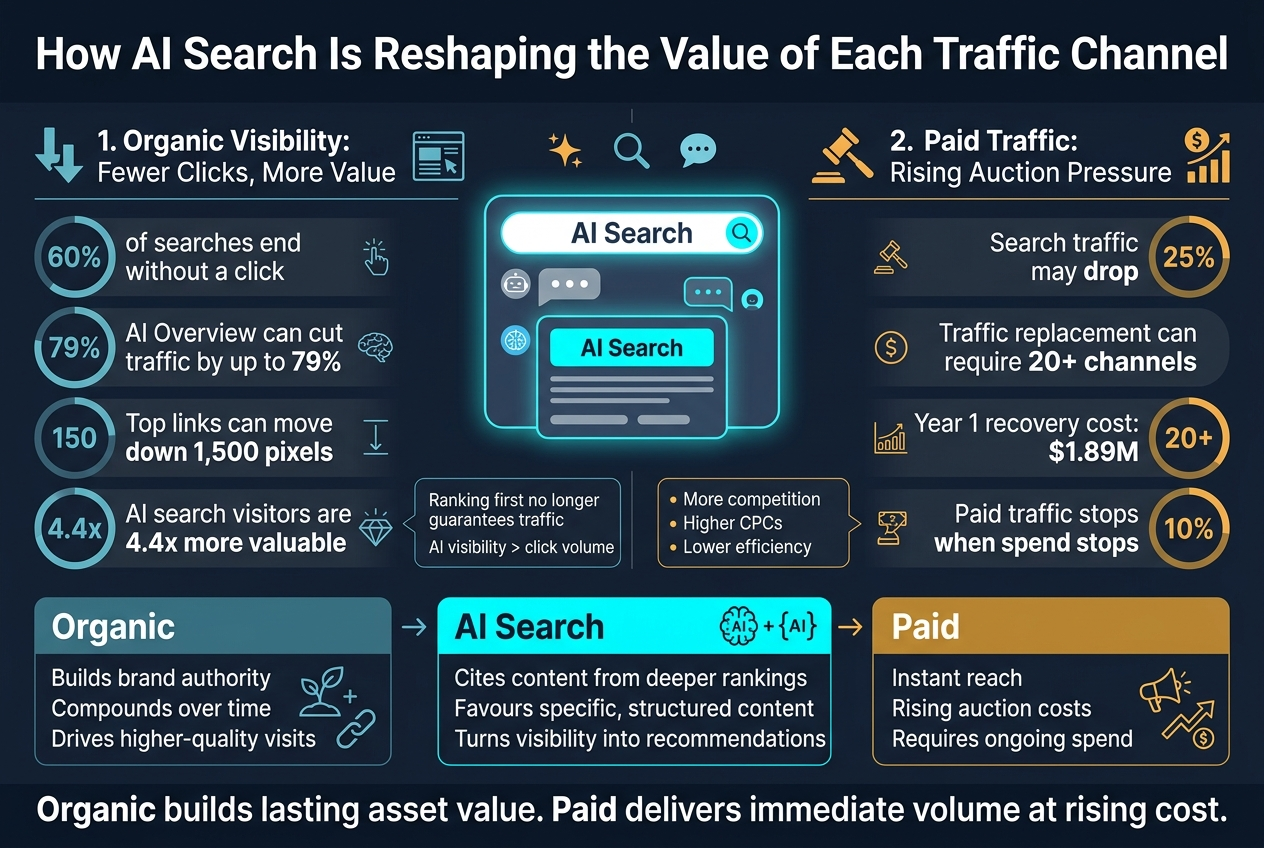
How AI Search Is Reshaping the Value of Each Traffic Channel
The landscape of digital marketing has never stayed still for long, but the changes brought on by AI search are in a different category entirely. They are not incremental shifts in algorithm behavior or minor adjustments to ranking signals. What is happening right now is a structural reorganization of how information reaches people, how they interact with it, and — critically — whether they ever click through to your website at all.
For anyone managing or planning around organic vs. paid traffic, the emergence of AI-powered search experiences has introduced a new set of rules that neither channel can afford to ignore. Both organic and paid traffic are being reshaped by these forces, but they are being reshaped in entirely different ways and at different speeds. Understanding those differences is not just strategically useful — it is essential for making sound decisions about where to direct resources, effort, and budget in the years ahead.
What follows is a close examination of how AI search is specifically redefining the value of organic visibility on one side, and what it means for the growing auction competition facing paid traffic on the other.
A. Why Organic Visibility Now Matters More Than Click Volume
For the better part of two decades, the central metric of organic search success has been traffic. Rankings were pursued because they drove clicks, clicks drove sessions, and sessions drove conversions. The logic was linear and relatively predictable. Ranking on page one meant a certain volume of traffic, and that traffic, when qualified enough, produced measurable revenue.
That model is now under serious stress — not because organic search has become less important, but because the relationship between organic visibility and click volume is breaking down. AI search is inserting itself between the query and the click, and in doing so, it is changing what it means to “win” in organic search.
The Click Is No Longer the Primary Unit of Value
Roughly 60% of searches now end without a click, according to data from Bain, as AI-generated answers satisfy users directly on the results page. This is not a marginal figure. It means the majority of search interactions are being resolved before the user ever reaches a website. For a channel built on the premise that visibility leads to visits, this represents a profound disruption.
Google’s AI Overviews and AI Mode are central to this shift. AI Overviews — the AI-generated summaries that appear above traditional search results — compress the information delivery process. When a user’s question is answered within the search results page itself, the incentive to click through to source content is dramatically reduced. Research from The Guardian found that websites that once ranked first for a given query can lose up to 79% of their traffic when an AI Overview appears for that query. That figure is not an outlier. It is emblematic of a systemic restructuring of how clicks are distributed across the web.
Furthermore, Google’s AI Overviews can push top-ranked links down by as much as 1,500 pixels — the equivalent of roughly two full screen scrolls on desktop and three on mobile. When top-performing pages are displaced that far down the visible hierarchy, click-through rates drop sharply, regardless of ranking position.
Users are also more likely to end their search session entirely after seeing a page with an AI summary than after visiting one without it, according to Pew Research. The session, in other words, terminates within Google’s environment rather than continuing on to a publisher’s website. Roughly two-thirds of all searches, whether or not an AI summary appeared, resulted in users either staying within Google or leaving entirely without clicking to any external site.
What This Means for Organic Traffic Strategy
The instinctive reaction to these numbers is alarm. And in terms of raw traffic volume, that reaction is warranted. Gartner projects search engine traffic to drop 25% as AI search becomes more prevalent. If traditional organic traffic numbers are declining, and if that decline accelerates as more users adopt AI-native search behaviors, then the entire foundation of traffic-volume-based SEO strategy needs to be reconsidered.
But here is where the analysis becomes more nuanced and, ultimately, more useful: declining click volume does not mean declining value. It means the value per visit is increasing. And that shift has significant implications for how organic visibility should be measured, pursued, and defended.
Research conducted across more than 500 high-value digital marketing and SEO-related topics found that the average AI search visitor is 4.4 times as valuable as the average visit from traditional organic search, based on conversion rate. That is not a small premium. It is a fundamental revaluation of what a qualified organic visit is worth.
The reason for this elevated value is directly tied to how AI search works. By the time an AI search user visits a website, they have typically already gone through a significant portion of the decision-making process within the AI interface itself. They have compared options, evaluated value propositions, and received what amounts to personalized guidance. When they then arrive at a website, they are arriving as a far more primed and informed prospect than the typical organic search visitor who clicks through from a traditional ten-blue-links results page.
AI responses are also presented in a manner that resembles personal, word-of-mouth recommendations — conversational, contextual, and tailored. This framing may carry more emotional resonance and persuasive weight than a standard search result snippet. A user who acts on an AI recommendation is, in effect, following trusted advice rather than clicking a link they found in a list.
Visibility in AI Systems Is Not the Same as Rankings in Traditional Search
This is one of the most important conceptual shifts that any organic traffic strategy needs to make: AI search visibility and traditional search rankings are related, but they are not the same thing.
Data from a study examining how AI systems cite content found something that challenges conventional SEO wisdom. When ChatGPT search cites webpages, the pages it cites rank in traditional organic search positions 21 and beyond almost 90% of the time. Perplexity and Google’s LLMs also frequently cite pages that rank lower in traditional search results.
The implications of this finding are significant. It means that a page does not need to rank in the top five — or even the top twenty — of traditional search results to be cited, recommended, and featured in AI-generated responses. The playing field for AI visibility is substantially broader than the narrow band of page-one real estate that traditional SEO has fought over for years.
There are compelling reasons for this pattern. First, the sheer volume of content available outside positions one through twenty gives AI systems a much larger pool to draw from. Second, AI search experiences are designed primarily to surface relevant information — not entire webpages as holistic units. This means AI systems can evaluate and cite discrete, high-quality content segments without requiring the surrounding page to have strong traditional ranking signals like domain authority, link velocity, or technical page experience metrics. Third, AI systems have a more sophisticated capacity to model user intent than traditional search engines. They can process natural language queries, gain context through multi-turn conversation, and build understanding of individual users over time. This allows them to prioritize the best response for a specific user rather than the best result for the average user — a distinction that opens the door to content that is highly specific, niche, and audience-tailored.
Some LLMs, however, do cite pages ranking in positions one to five more often than pages in positions six to twenty, suggesting that strong traditional rankings may still provide a signal advantage. But the dominant pattern — citing from positions 21 and beyond — indicates that traditional ranking supremacy is no longer the sole determinant of AI visibility.
Why Organic Visibility in the AI Era Requires a New Framework
The data establishes something that requires a rethinking of what organic visibility actually means. Ranking first for a broad keyword no longer guarantees the traffic it once did. At the same time, content that would never have appeared in the top ten of traditional search results can now be featured prominently in AI responses reaching large, high-intent audiences.
This reconfigures the entire strategic logic of organic content investment. The question is no longer simply “how do we rank for this keyword?” It is “how do we become the source that AI systems trust, cite, and recommend for this topic?”
Answering that question requires a different approach to content. Research consistently points to the value of highly specific, audience-tailored content — the kind that addresses narrow, niche questions rather than broad informational queries. AI systems appear to be more likely to cite content that is tailored to specific use cases and audiences. This type of content performs well in AI environments precisely because it addresses the kind of detailed, contextual questions that AI search users ask.
Practical implications include creating product guides tailored to specific verticals, publishing detailed answers to niche questions that might previously have been considered too narrow to warrant standalone content, and developing comparison guides that help AI systems — and the users they serve — understand the distinctions between offerings and alternatives.
Content format and structure also matter more than ever. AI systems use natural language processing (NLP) to interpret content, which means writing clearly, using descriptive headings, mentioning relevant entities, and structuring content in a way that makes key information easy to extract. Presenting information in a quotable or easily “chunkable” format increases the likelihood that an AI system will extract and cite specific passages. Content that is disorganized, overly dense, or reliant on implicit knowledge is less likely to be used by AI systems even if it ranks strongly in traditional search.
Technical considerations are also shifting. Many AI crawlers will not execute JavaScript, which means content rendered client-side may be invisible to AI systems regardless of its quality or relevance. Ensuring that pages are crawlable in a straightforward, server-rendered format is increasingly important for AI visibility.
The Continued Importance of Traditional SEO Foundations
Despite all the changes AI search introduces, the foundation of traditional SEO has not become irrelevant — far from it. Good news for businesses that have invested in organic content: traditional SEO factors continue to drive a large portion of brand visibility in LLMs. Publishing helpful content, ensuring webpages are crawlable, and earning brand citations — which function like branded backlinks that do not need to be actively linked — all contribute to how AI systems perceive and represent a brand.
The underlying reason is that LLMs learn from vast amounts of online content. Brands that have established credibility, published authoritative content, and earned citations across the web have, in effect, already begun building the kind of presence that AI systems draw on when formulating responses. The SEO work done today is not just an investment in traditional search rankings — it is an investment in how AI systems will understand and represent a brand for years to come.
The distinction is that LLM optimization is not exactly the same as traditional SEO, even if the two overlap substantially. The goal is no longer just to rank in traditional search — it is to be present in the information ecosystem that AI systems learn from and reference. This includes being featured on high-authority domains that AI systems frequently cite, maintaining consistent brand messaging across all marketing channels, and managing brand sentiment across the web, since AI systems may incorporate both favorable and unfavorable brand mentions into their responses.
Quora and Reddit, for instance, are among the most commonly cited websites in Google AI Overviews, according to research. These platforms are rich sources of niche, question-driven content — exactly the kind of material AI systems draw on for specific prompts. Being present in conversations on these platforms, or earning citations through digital PR and link-building, can meaningfully contribute to AI search visibility even without changing a single word of content on a company’s own website.
Organic Visibility as Brand Infrastructure
Taken together, these developments reframe organic visibility as something closer to brand infrastructure than a traffic mechanism. When AI systems learn from and cite your content, they carry your brand’s perspective, value proposition, and authority into the responses they deliver to millions of users — users who may never click through to your site but who are nonetheless being shaped by your presence in the AI information ecosystem.
This has long-term compounding implications. Brands that establish themselves as reliable, frequently cited sources in AI responses will benefit from compounding recognition over time. As AI search habits deepen — ChatGPT weekly active users grew 8x from October 2023 to April 2025 to over 800 million users — the brands woven into those AI responses will have a structural advantage that is difficult for later entrants to replicate.
Research projects that AI search visitors will surpass traditional search visitors from digital marketing and SEO-related topics by early 2028, and potentially much sooner if Google’s AI Mode — which completely replaces the traditional search results page with a ChatGPT-like experience — becomes the default. The window for establishing AI visibility before competitors do is narrowing.
For the purposes of comparing organic vs. paid traffic, this means that organic’s long-term value is not diminishing — it is being redirected. Instead of driving click volume, organic visibility is increasingly driving brand presence in AI systems, qualified visitor quality, and the compounding authority that shapes AI recommendations over time. Traffic volumes may decline in the short term, but the strategic value of strong organic visibility — particularly when optimized for AI systems — is growing.
This is a critical point for any long-term traffic strategy. The businesses that respond to declining organic click volume by abandoning SEO and content investment will surrender precisely the foundation that AI visibility is built on. Those who double down on authoritative, specific, well-structured content — while adapting their measurement frameworks to account for AI-driven brand presence, not just click-through rates — are positioning themselves for growth in the emerging AI-dominant search environment.
Measuring Organic Value in the AI Era
One of the practical challenges this transition creates is measurement. If a significant portion of AI search traffic arrives via direct navigation — because users manually navigate to a website after seeing an AI response — or if traffic attribution is lost because AI links do not always carry referrer data, then standard analytics frameworks will systematically undercount the value of organic and AI-driven visibility.
Research modeling the impact of AI search on traffic projections explicitly accounts for these scenarios: clicks from AI links that arrive without referrer data and are attributed as direct traffic, users who navigate manually after viewing an AI response, and users who are primed to purchase by AI exposure but complete that purchase through a later visit via branded search. In each of these cases, the organic or AI-driven influence on the conversion is real but invisible to standard last-touch attribution.
This means that businesses measuring the success of their organic and AI visibility strategy purely through traffic volume and session counts will structurally underestimate the return on that investment. A more sophisticated approach accounts for branded search growth, direct traffic trends, and conversion rate changes by channel — all of which can serve as proxy signals for growing AI-driven brand presence.
For businesses navigating the organic vs. paid traffic decision, this measurement complexity further strengthens the case for maintaining and growing organic investment even as visible click volumes soften. The value is real; it is simply flowing through channels that standard attribution does not always capture cleanly.
B. Why Paid Traffic Faces Growing Auction Competition
With this in mind, now we turn to the other side of the equation. If AI search is reshaping organic visibility in the ways described above, it is doing something equally significant — and in some respects more immediately costly — to the paid traffic landscape.
The paid search and paid digital advertising ecosystem operates on competitive auction mechanics. Advertisers bid for visibility, and the price of that visibility is determined by how many competitors are bidding for the same inventory. When market conditions shift — when organic traffic declines and businesses need to replace lost sessions — the natural response is to increase paid spend. But that response, when made across an entire market, drives up the cost of every auction, making paid traffic progressively more expensive even as businesses become more dependent on it.
The Traffic Displacement Problem and the Paid Demand Spike
Understanding why paid auction competition is intensifying requires understanding the scale of the traffic displacement problem that AI search is creating across the market.
When AI Overviews and AI Mode satisfy user queries without generating clicks, the traffic that previously flowed from search to websites disappears. For individual businesses, that disappearance might represent thousands or tens of thousands of sessions per month. Across the market, it represents an enormous volume of traffic that businesses previously relied on and now need to replace.
The instinctive — and often correct — immediate response is to turn to paid channels. Historically, paid digital channels including paid social, native ads, search, and display could recover approximately 40% to 45% of lost organic traffic. Owned media channels such as email, video, webinars, and guest content could deliver another 25% to 30% while building compounding long-term value. The remaining gap requires partnerships, marketplaces, events, outbound efforts, and emerging channels, each contributing incrementally.
But here is the structural problem: when every business in a market simultaneously increases paid spend to compensate for lost organic traffic, auction prices rise for everyone. The advertiser who was paying a certain cost-per-click six months ago is now competing against a larger pool of bidders who all have the same problem and the same solution in mind. The cost of paid traffic goes up, the return per dollar spent goes down, and the efficiency of paid channels erodes precisely at the moment businesses need them most.
This dynamic is not hypothetical. It is an inevitable consequence of the market mechanics of paid search and paid social advertising, applied to a situation where a major free traffic source — organic search — is experiencing structural decline.
The True Cost of Traffic Replacement at Scale
To appreciate the magnitude of what businesses face, it is worth examining what replacing lost organic traffic through paid and other channels actually costs. Research modeling a scenario where businesses need to recover a significant volume of lost sessions — in the range of 120,000 monthly sessions — concludes that recovering lost sessions at scale requires running 20 or more channels simultaneously, backed by more talent, better tools, and sustained investment as each program matures.
Even conservatively, a Year 1 plan to rebuild reach at that scale can require nearly $1.89 million in annual spend, stabilizing at roughly $225,000 per month. That is the cost of replacing what organic search delivered effectively for free, through content investment rather than direct media spend.
This cost is not borne equally. Businesses that had large organic audiences built over years of SEO investment face the largest replacement costs because they have the most traffic to replace. Businesses in competitive verticals — B2B SaaS, marketing platforms, content-heavy businesses — face particularly acute pressures because their category keywords tend to have higher cost-per-click rates, making paid traffic more expensive per session than in less competitive verticals.
The competitive pressure is also not static. As more businesses pursue paid channels to replace lost organic traffic, the auction dynamics push prices higher, increasing the cost of replacement over time. This means the $1.89 million figure is likely a floor, not a ceiling, for high-traffic businesses in competitive markets. The businesses that delay their response will find the cost of replacement has grown by the time they act.
Why Paid Traffic Cannot Simply Replace Organic Traffic
The cost dynamics described above would be challenging enough if paid traffic were a perfect substitute for organic traffic. But it is not — and understanding why matters for the organic vs. paid traffic balance question.
Paid traffic, by its nature, stops the moment spending stops. Every session delivered by a paid ad is a session that costs money, and when the budget is exhausted or cut, the traffic disappears immediately. This creates a fundamentally different growth dynamic than organic traffic, where content published today can continue delivering value — through citations in AI systems, through traditional rankings, through direct navigation — for years without additional per-session spend.
Organic traffic, particularly when the visibility translates into AI search presence, has compounding properties. A piece of content that establishes a brand’s authority in AI systems today will continue influencing responses — and the purchasing decisions those responses inform — long into the future. Paid traffic has no equivalent compounding mechanism. Every dollar spent on paid traffic generates traffic only for as long as the spending continues.
This difference becomes increasingly important as AI search reshapes the environment. If paid competition is intensifying, the cost of sustaining paid traffic volumes is rising. If organic and AI visibility is simultaneously building compounding authority, then the businesses that maintain both channels are increasingly differentiated from those that abandon organic in favor of an all-paid strategy.
The Structural Limitations of Paid Traffic in an AI Search Environment
Beyond auction competition, paid traffic faces another set of structural limitations that AI search is amplifying. Traditional paid search operates by showing ads alongside search results. But as AI search increasingly replaces traditional search result pages — particularly if Google’s AI Mode becomes the default experience — the inventory of search advertising placements shrinks or changes in character.
If AI Mode completely replaces the traditional search results page, as it is beginning to do in Google’s rollout, the environment in which traditional paid search ads have always appeared is fundamentally altered. Advertisers will need to adapt to new ad formats, different placement locations, and different user behavior patterns as the search interface evolves.
This is not a distant scenario. Google has already begun rolling out AI Mode broadly, and the pace of adoption is accelerating alongside the growth in AI search usage generally. ChatGPT’s weekly active users grew 8x between October 2023 and April 2025, reaching over 800 million. As AI search interfaces become more familiar and accessible, user reliance on traditional search results — the environment where most paid search ads appear — will decline further.
Paid social and display advertising do not face the same direct disruption from AI search interfaces, but they are not immune from the competitive pressure effects. As more businesses diversify their paid spend away from search and into social, native, and display channels to compensate for declining search traffic, those channels become more competitive and more expensive as well. The auction pressure propagates across the paid ecosystem.
The Channel Diversification Requirement and Its Cost Implications
One of the most important strategic implications of the AI search disruption for paid traffic is that no single paid channel can replace what organic search once delivered. Historically, paid search was itself a highly efficient traffic channel because it intercepted users with high purchase intent at the moment of their search. But as search behavior migrates to AI interfaces, and as traditional paid search inventory changes, businesses cannot rely on paid search alone.
This forces a diversification requirement that dramatically increases the complexity and cost of paid traffic strategies. Building and managing effective programs across 20 or more channels simultaneously — paid social, native ads, display, programmatic, video, podcast, partnership, marketplace, and more — requires more talent, more tooling, more creative assets, and sustained management attention. The operational overhead of a truly diversified paid strategy is substantial, and it grows as channel count increases.
Each of these paid channels contributes only a fraction of the traffic that a robust organic search presence once delivered. Together, they can rebuild reach, but at a cost that makes the economic case for organic and AI visibility investment significantly stronger in comparison.
The Risk of Paid Dependence Without Organic Foundation
For businesses that have historically balanced organic and paid traffic effectively, the risks of over-pivoting toward paid in response to AI search disruption are significant. Paid traffic creates operational dependency — a constant requirement to maintain spending, manage campaigns, monitor performance, and optimize creative in order to sustain traffic volumes. When spending is reduced for any reason — budget cuts, economic downturns, competitive pressure — traffic falls immediately and directly.
Organic traffic and AI visibility, by contrast, create structural assets. Content, brand authority, citations in AI systems, and high-authority domain presence all have residual value that persists beyond the immediate period of investment. A business that has built strong AI visibility through quality content and brand authority has an asset that competitors cannot easily purchase or replicate. Its paid spending competes against many others in open auctions; its AI visibility is the product of specific, documented brand authority that has been established over time.
The fundamental economic logic of organic vs. paid traffic is therefore shifting in a direction that strengthens the case for organic and AI visibility investment: as paid auction competition intensifies — driven by the market-wide response to AI search disruption — the relative cost-efficiency of organic and AI visibility becomes more favorable. The businesses that maintain organic investment while adapting it for AI search environments will find that their long-term cost of customer acquisition is structurally lower than those that have become entirely dependent on paid channels.
Paid Traffic’s Role in the Transitional Period
None of this is to suggest that paid traffic has become irrelevant or that businesses should reduce paid investment in response to AI search disruption. The reality is more nuanced. During the transitional period — as AI search habits establish themselves and as organic and AI visibility strategies build their compounding effects — paid traffic remains an essential mechanism for maintaining volume.
The key insight is about proportion and trajectory. Businesses that use paid traffic to sustain volume during the transition while simultaneously investing in organic content and AI visibility optimization are building the right combination of immediate reach and long-term structural advantage. Businesses that respond to AI search disruption by increasing paid spend without building organic and AI visibility are solving a short-term volume problem while creating a long-term competitive disadvantage.
The costs of replacing even a modest volume of lost organic sessions through paid channels — modeled at nearly $1.89 million annually for significant traffic replacement — make a compelling financial case for treating organic and AI visibility investment not as a discretionary content budget but as a strategic infrastructure investment with long-term return characteristics.
Balancing the Two Realities
The picture that emerges from examining both sides of the AI search impact is one of increasing divergence between the short-term mechanics of paid traffic and the long-term structural value of organic and AI visibility.
Paid traffic remains a powerful tool for precision targeting, immediate reach, and controlled volume — but growing auction competition, driven by market-wide responses to AI search disruption, is making it more expensive and less efficient over time. The environment in which paid search has traditionally operated is also being structurally altered by the migration of search behavior to AI interfaces.
Organic visibility, meanwhile, is being redefined by AI search. Click volumes from traditional organic search are declining, but the quality and value of visits that do arrive — particularly those driven by AI search recommendations — is increasing dramatically. The 4.4x conversion rate premium of AI search visitors over traditional organic search visitors is a signal that brands visible in AI systems are reaching far more qualified audiences per visit than they have historically through traditional organic channels.
With this in mind, next, we’ll see how these shifting dynamics should inform decisions about which channel to prioritize at different business stages — because the right balance between organic and paid depends not just on market conditions, but on where a business is in its growth trajectory and what resources it has available to invest in each channel’s specific requirements.
The AI search disruption has, in effect, raised the strategic stakes of the organic vs. paid traffic question significantly. It is no longer simply a question of which channel delivers more sessions more cheaply. It is a question of which channel builds the kind of lasting presence — in AI systems, in brand authority, in earned visibility — that will compound in value as the search landscape continues to evolve. And it is a question of how to navigate the growing cost pressures of paid auction competition while building that organic and AI visibility foundation.
For businesses managing long-term traffic strategy, the AI search era demands both channels — but demands them with a clearer understanding of what each delivers, what each costs over time, and how each is being reshaped by the most significant structural change in search since the advent of Google itself. Organic visibility now matters more than click volume. Paid traffic faces mounting auction pressure. And the businesses that understand both of these realities deeply will be the ones best positioned to navigate what comes next.
The compounding insight from the data is this: AI search is not eliminating the value of organic investment — it is concentrating and intensifying it. The brands with strong organic foundations are the same brands that AI systems learn from, cite, and recommend. And the brands that are already cited in AI systems are the ones delivering 4.4x more valuable visitors, converting more efficiently, and building the kind of structural market presence that no paid campaign can replicate at scale.
Meanwhile, every business that abandons organic investment in favor of paid channels contributes to the very auction competition that makes those paid channels more expensive. The businesses that hold firm on organic investment while adapting it for the AI era are, in a very real sense, letting their competitors run up the cost of paid traffic while they build an asset that pays dividends long after any individual campaign ends.
Choosing the Right Channel for Your Business Stage
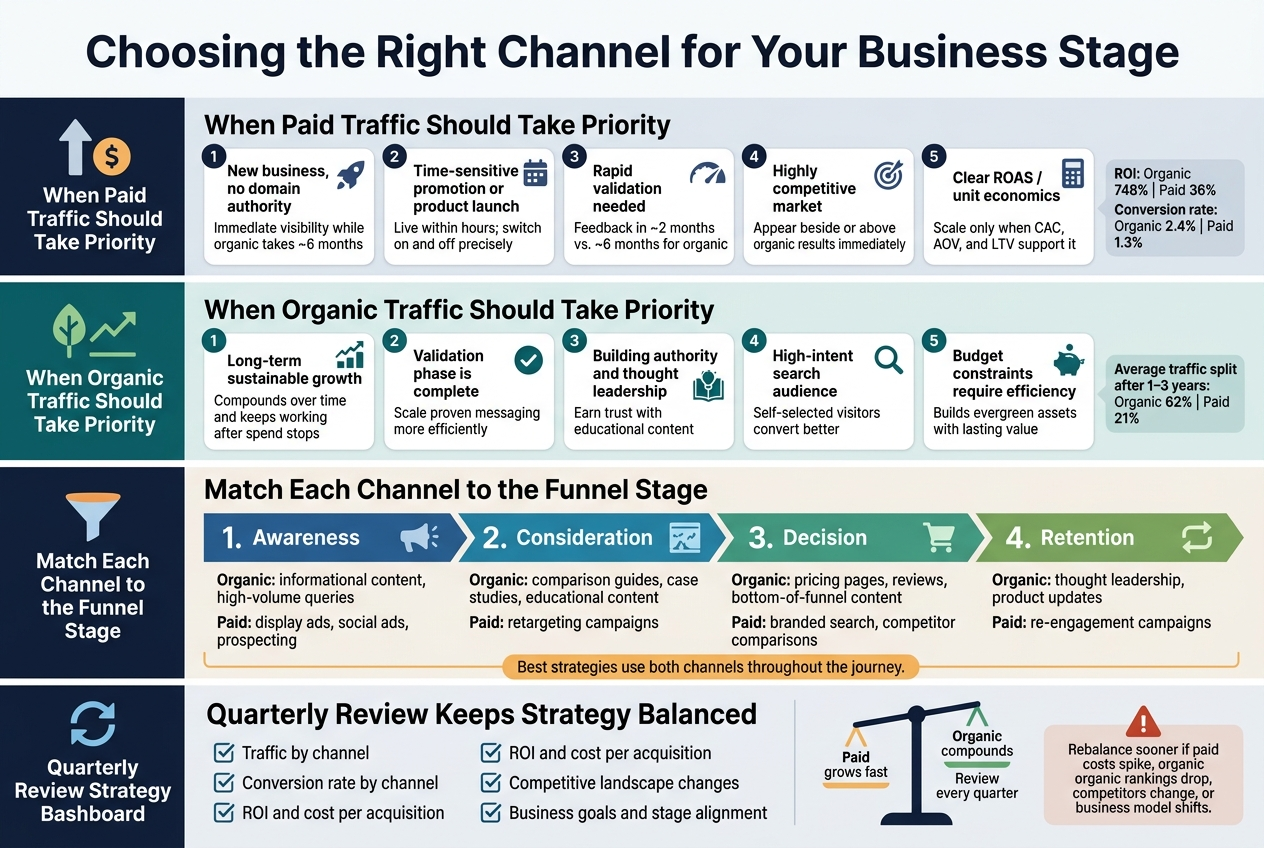
When Paid Traffic Should Take Priority
Understanding when to deploy paid traffic versus organic traffic is one of the most consequential decisions a business can make in its digital marketing strategy. The timing, context, and stage of your business all play defining roles in determining which channel deserves the bulk of your budget and attention at any given moment.
Paid traffic channels provide much faster returns than organic ones, and this speed advantage becomes critically important in specific business situations. While organic traffic delivers a significantly higher ROI over the long term — with data showing organic ROI at 748% compared to paid’s 36% — there are clear circumstances where the immediacy of paid advertising is not just useful but essential.
You Are a New Business With No Domain Authority
When a business launches its digital presence, it starts with zero accumulated trust, zero indexed content, and zero keyword rankings. Organic traffic campaigns take an average of six months before meaningful results begin to materialize. For a brand-new website competing in any established market, the waiting period before organic traffic becomes a reliable source of leads can stretch even longer depending on competitive intensity.
During this early phase, paid traffic fills a critical gap. It allows a new business to appear immediately on search engine results pages, drive visitors to its offerings, and begin generating revenue while the longer-term organic strategy is being built in parallel. Without this bridge, many new businesses would face extended periods of near-zero traffic with no visibility into whether their messaging, products, or positioning resonates with their target audience.
The learning curve for paid campaigns is classified as low compared to the medium learning curve associated with organic traffic. This means a business can get a paid campaign operational relatively quickly, with a campaign manager and copywriter being the primary resources required, compared to the larger team typically needed for organic efforts — a strategist, writer, web developer, graphic artist, and manager.
This makes paid traffic a more accessible starting point for businesses that lack the in-house expertise, content infrastructure, or time to build an organic presence from scratch.
You Are Running a Time-Sensitive Promotion or Product Launch
Short-term promotions or new product introductions can benefit greatly from support from paid campaigns. This is one of the most universally applicable use cases for paid advertising, regardless of how strong your organic presence might be.
Organic content, by its nature, earns visibility over time. A blog post written today to support a new product launch may not rank meaningfully for weeks or months — well after the promotional window has closed. Paid campaigns, by contrast, can be live within hours, placing your message directly in front of targeted audiences at the exact moment the promotion is active.
Consider a seasonal sale, a limited-time offer, or a product releasing on a specific date. The value of that traffic is entirely dependent on its timing. A visitor arriving after the promotion ends is not only useless for conversion purposes, but may create a negative brand experience. Paid advertising’s ability to be switched on and off with precision makes it the correct tool for these scenarios, where the value of visibility is tied directly to a specific time window.
Your Industry or Business Model Demands Rapid Validation
For businesses testing a new market, a new offer, or a new audience segment, paid traffic provides data at a speed that organic strategies simply cannot match. When you need to know quickly whether a particular message converts, whether a price point works, or whether a specific audience segment responds to your offer, paid campaigns compress that feedback loop significantly.
The time until results for a paid campaign is approximately two months, compared to six months for an organic traffic campaign. In practical terms, this means paid advertising can return actionable data within weeks of campaign launch. This speed of validation is not just a convenience — it can be a strategic necessity for businesses operating with limited runway, navigating competitive markets, or making high-stakes decisions about product direction.
Your Competitive Landscape Demands Immediate Presence
In highly competitive industries where established players dominate the top organic search results, it can take considerable time and investment for a newer entrant to break through organically. If the top three organic positions for your most valuable keywords are held by companies with years of content investment and domain authority behind them, waiting six months or more to compete organically may mean losing substantial market share in the meantime.
Paid search advertising allows you to appear alongside or even above organic results for your most important keywords immediately. You are, in effect, buying your way into visibility while you do the longer-term work of earning it. This is a rational and often necessary approach during a competitive ramp-up phase.
You Have a Clear, Measurable Return on Ad Spend
Paid traffic is most defensible when the conversion economics are well understood. If you know your customer acquisition cost, your average order value, and your customer lifetime value, you can calculate whether a paid campaign is profitable. When those numbers work, paid traffic becomes a lever that can be scaled deliberately. When they don’t, that’s a signal to revisit either the campaign itself or the role paid traffic should play in your broader mix.
The conversion rate for paid traffic is 1.3%, compared to organic’s 2.4%. While paid converts at a lower rate, the ability to control spend precisely, target audiences with specificity, and generate traffic volume on demand still makes it viable when the unit economics support it — particularly for high-value products or services where even a modest conversion rate produces strong revenue returns.
When Organic Traffic Should Take Priority
Now that we have covered the specific circumstances where paid traffic earns its place, it is equally important to recognize the conditions under which organic traffic should become the primary investment. The case for organic traffic is compelling across multiple dimensions, and understanding when those advantages apply most powerfully will help you allocate resources more intelligently.
You Are Building for Long-Term, Sustainable Growth
The most fundamental argument for prioritizing organic traffic is its compounding nature. Unlike paid traffic, which stops the moment you stop spending, organic traffic continues to generate value from content and rankings that were earned months or even years ago. This compounding dynamic is at the heart of what makes organic traffic so powerful for sustainable website traffic growth.
When a business invests in organic traffic growth for one to three years, the results are dramatic. According to internal data from companies actively investing in both SEO and paid advertising, organic traffic accounts for 62% of total traffic on average, compared to paid’s 21%. This is not because paid traffic is neglected, but because organic traffic, when well-executed over time, naturally dominates as the leading traffic source.
This long-term accumulation of value fundamentally changes the economics of your marketing. The ROI for organic traffic, at 748%, dwarfs the 36% ROI seen with paid campaigns. While it takes longer to realize, the compound effect of consistently growing organic rankings means that each subsequent month of investment delivers more return than the last, rather than requiring ever-increasing spending to maintain a constant level of traffic.
You Have Completed the Validation Phase and Know What Works
Early-stage businesses often need the rapid feedback loop of paid advertising to learn what messaging resonates, which audiences convert, and which offers perform. Once that learning has occurred, however, organic content becomes the more efficient vehicle for scaling those validated messages over the long term.
Rather than paying repeatedly to reach an audience for a message you’ve already proven works, you can invest in creating high-quality organic content around the same themes, keywords, and audience needs — and continue generating traffic from that investment indefinitely. This transition from paid validation to organic scaling is a natural and financially sound progression for businesses that have moved through the early discovery phase.
You Are Establishing Authority and Thought Leadership in Your Industry
Success with organic traffic requires knowing your audience, conducting keyword research, and developing content that aligns with search intent. When done well, this process does far more than generate traffic — it establishes your company as a thought leader in your industry.
Paid ads, by contrast, do not build credibility in the same way. They can place your message in front of an audience, but they do not inherently demonstrate expertise, provide educational value, or earn trust over time. Organic content, through well-researched articles, guides, case studies, and resources, creates a body of work that signals expertise to both search engines and human readers.
For businesses in complex industries — financial services, healthcare, professional services, B2B technology, and others — where trust is a major factor in the buying decision, this thought leadership dimension of organic content is not a secondary benefit. It is often the primary driver of high-quality lead generation. Buyers in these spaces research extensively before making decisions, and the businesses whose content they encounter repeatedly during that research process are the ones they are most likely to contact when they are ready to buy.
Your Audience Demonstrates High Intent Through Organic Search
Organic search visitors are, by definition, people who typed a specific query into a search engine and found your content relevant enough to click through. This intent signal is one of the most powerful in digital marketing. A visitor arriving via organic search for “best enterprise project management software” is signaling a very specific interest at a meaningful point in their buying journey.
This intent alignment contributes directly to organic traffic’s superior conversion rate of 2.4% compared to paid’s 1.3%. When your content is well matched to the search intent behind the queries you rank for, the visitors who arrive are already partially qualified — they sought out information in your area, found your content relevant, and chose to engage with it. That self-selection process produces higher-quality traffic that converts at a higher rate.
Your Marketing Budget Has Constraints That Demand Efficiency
While both organic and paid traffic can cost similar monthly amounts — organic typically running $8,000–$15,000 per month and paid ranging from $5,000–$20,000 per month — the nature of those costs is fundamentally different. Paid spend is consumed as traffic; when you stop spending, the traffic stops. Organic spend builds an asset that continues to deliver returns after the work is done.
For businesses with budget constraints, this difference in how spending translates to long-term value is significant. A piece of content created as part of an organic strategy twelve months ago can still be driving qualified traffic and leads today, with zero additional spend required. That accumulation of evergreen assets makes organic traffic a more capital-efficient approach for businesses that need to maximize the long-term return on every marketing dollar spent.
How to Match Each Channel to the Right Funnel Stage
With this in mind, next, we’ll see how organic and paid traffic channels are not equally well-suited to every stage of the customer journey. Understanding how to deploy each channel strategically across your funnel is one of the most powerful ways to maximize the combined effectiveness of your organic and paid efforts.
The customer journey from awareness to conversion is rarely linear, but it does move through recognizable phases. Different traffic channels perform better at different stages of that journey, and matching the right channel to the right funnel stage produces both better conversion outcomes and more efficient use of marketing resources.
Awareness Stage: Broad Reach and First Impressions
At the top of the funnel, the goal is exposure — introducing your brand, your content, or your solutions to people who may not yet know they have a problem your business can solve, or who are just beginning to recognize that problem.
Paid traffic can play an effective role at this stage, particularly through display advertising and social paid campaigns that reach audiences based on demographic or interest targeting rather than active search behavior. The ability to place your content or brand in front of a cold audience at scale is one of paid advertising’s distinct advantages in the awareness phase.
Organic content also contributes meaningfully at the awareness stage, particularly through informational content that ranks for early-stage, high-volume search queries. Someone searching “how to improve customer retention” may not yet be in the market for a CRM platform, but a B2B software company that provides a genuinely useful answer to that question has created a first impression — and potentially planted a seed for a future sales conversation.
The important distinction here is that paid traffic at the awareness stage requires continuous investment to maintain visibility. Organic content that earns rankings for awareness-stage queries continues to generate that first-impression traffic indefinitely.
Consideration Stage: Building Trust and Demonstrating Value
In the middle of the funnel, prospects are actively evaluating options. They have identified their problem and are researching solutions. This is where the thought leadership dimension of organic content becomes especially powerful.
Content formats that perform well at this stage include detailed comparison guides, in-depth product or service explanations, case studies, and educational resources that help prospects understand their options and make informed decisions. These content types take time to produce and time to rank — but once established, they work continuously to move prospects through the consideration phase.
Paid traffic at the consideration stage often takes the form of retargeting campaigns — serving ads to people who have already interacted with your website or content. Because these visitors have already demonstrated some level of interest, retargeting is typically more efficient than cold prospecting. A visitor who read a blog post about your product category and then sees a retargeted ad for a relevant offer is a fundamentally warmer prospect than someone encountering your brand for the first time.
The interplay between organic and paid at this stage is particularly important. Your organic content creates the initial engagement; paid retargeting can maintain your brand’s presence as that prospect continues their evaluation journey.
Decision Stage: Converting High-Intent Visitors
At the bottom of the funnel, visitors are close to making a purchasing decision. Search queries at this stage tend to be highly specific — including brand names, product comparisons, pricing searches, and “best [solution] for [specific need]” type queries.
Organic traffic at the decision stage is enormously valuable. A prospect who finds your pricing page, a detailed product comparison, or a positive review through organic search is arriving with extremely high purchase intent. Ranking well for these bottom-of-funnel queries requires targeted content investment, but the conversion value of that traffic is high.
Paid search advertising is also highly effective at the decision stage, particularly for high-value keywords with strong commercial intent. Bidding on your own brand name, on direct competitor comparisons, or on “buy [product category]” type queries can capture ready-to-convert prospects efficiently.
The average traffic split data — with organic accounting for 62% and paid for 21% — reflects a portfolio approach where both channels are contributing across multiple funnel stages simultaneously. Rather than treating the funnel as a one-channel-per-stage framework, the most effective strategies use both channels throughout the journey, with each playing its most natural role.
Mapping Channel Strengths Across the Funnel
The following table illustrates how organic and paid traffic map to funnel stages based on their respective strengths:
| Funnel Stage | Organic Traffic Role | Paid Traffic Role | Primary Benefit |
|---|---|---|---|
| Awareness | Informational content, high-volume queries | Display ads, social paid, prospecting | Broad reach and first impressions |
| Consideration | Comparison guides, case studies, educational content | Retargeting campaigns | Trust building and evaluation support |
| Decision | Bottom-of-funnel content, pricing pages, reviews | Branded search, competitor comparisons | High-intent conversion capture |
| Retention | Thought leadership, product update content | Re-engagement campaigns | Customer loyalty and repeat purchase |
This framework is not prescriptive — every business has a unique funnel with specific characteristics — but it provides a useful starting point for thinking about how to allocate organic and paid investment across the customer journey.
Funnel Stage Alignment and Conversion Rate Implications
The conversion rate difference between organic and paid traffic — 2.4% versus 1.3% respectively — is partly a reflection of the intent quality of traffic each channel delivers by default. Organic search visitors tend to arrive with clearer intent signals, having actively sought information aligned with your content. This self-selection process contributes to stronger conversion performance.
However, this does not mean paid traffic is inherently less valuable — it means the conversion economics of paid traffic require more careful management. When paid campaigns are targeted toward bottom-of-funnel, high-intent keywords, conversion rates can be competitive. When paid budgets are concentrated at the awareness stage, conversion rates will naturally be lower, but the goal at that stage is not immediate conversion — it is brand introduction and audience building.
Matching your measurement expectations to the funnel stage you are targeting with each channel is as important as the channel allocation itself. Evaluating a top-of-funnel awareness campaign by the same conversion rate metrics used for a bottom-of-funnel search campaign will produce misleading conclusions and potentially result in cutting campaigns that are actually performing their intended role effectively.
Why a Quarterly Review Keeps Your Strategy Balanced
Previously, we’ve explored when to prioritize each channel and how to align them with funnel stages. Now, one of the most commonly overlooked elements of a sustainable long-term traffic strategy is the mechanism for maintaining balance over time. A channel allocation that makes perfect sense at one business stage or market condition can become misaligned as circumstances evolve — and without a structured process for reviewing and adjusting that allocation, businesses often continue running a strategy that no longer fits their current reality.
A quarterly review cadence is one of the most practical tools for keeping your organic vs. paid balance calibrated to your actual business situation. Understanding why this rhythm matters, what it should cover, and how it informs decision-making is essential to executing a long-term traffic strategy that remains responsive and effective.
Business Stages Are Not Static
One of the core insights from the reference data in this blog is that the right channel allocation depends heavily on where a business is in its development. A brand-new company has fundamentally different needs than one that has been investing in organic traffic growth for two to three years. A business launching a new product line may need to temporarily shift investment toward paid channels, even if organic has been the dominant strategy for years.
The problem is that these business stage transitions do not announce themselves loudly. They tend to unfold gradually — and without a structured review process, it is easy for marketing teams to continue running the same channel mix they established twelve or eighteen months ago, even when the conditions that justified that mix have changed substantially.
A quarterly review creates the forcing function to ask explicitly: is our current channel allocation still the right fit for where we are right now? This question, asked four times per year, catches drift before it becomes costly misallocation.
What to Review Each Quarter
A meaningful quarterly review of your organic vs. paid balance should cover several dimensions:
Traffic Performance Metrics by Channel
Begin with the actual traffic data: how much traffic is each channel delivering, and how has that changed over the past quarter? For businesses actively investing in organic growth, the expectation is steady growth in organic traffic share over time. According to the traffic split data, companies that have invested in organic growth for one to three years see an average split of 62% organic to 21% paid. If you are below that ratio and have been investing in organic for a significant period, that is a signal worth examining.
Conversely, if organic traffic has grown substantially, you may have room to reduce paid spend without materially impacting total traffic — freeing up budget that could be reinvested in accelerating organic content production.
Conversion Rate Performance by Channel
Organic traffic converts at 2.4% on average, compared to 1.3% for paid. These are benchmarks, not guarantees. Your actual conversion rates may differ based on your industry, your audience, the quality of your content, and the relevance of your paid targeting. A quarterly review is the right time to assess whether your channel-specific conversion rates are trending toward or away from these benchmarks — and to investigate the reasons behind any significant deviations.
If your organic conversion rate is declining, it may indicate that the quality of organic traffic has shifted, that your content is attracting visitors earlier in the buying journey, or that changes to your site are creating conversion friction. If paid conversion rates are dropping, it may signal audience fatigue, increasing competition for the keywords you are bidding on, or creative that needs refreshing.
ROI and Cost Per Acquisition by Channel
The ROI differential between organic (748%) and paid (36%) is substantial, but it plays out over different time horizons. Paid ROI tends to be more immediately measurable, while organic ROI accumulates over a longer period. A quarterly review should track the trajectory of cost per acquisition and overall return for both channels, with the understanding that organic’s ROI curve is expected to improve steadily over time while paid’s remains relatively constant.
If your paid cost per acquisition is rising — which often happens as ad markets become more competitive or as audience targeting becomes saturated — that is a clear signal to evaluate whether the budget currently allocated to paid could generate more long-term value if redirected toward organic content production.
Competitive Landscape Changes
Markets change. New competitors enter, existing competitors ramp up their paid spend or content output, and the organic search landscape shifts as search engine algorithms update. A quarterly review provides a structured opportunity to assess whether the competitive context your strategy was built around still reflects reality.
If a competitor has significantly improved their organic rankings for your most important keywords, that is a signal to either accelerate your own organic content investment or, in the short term, consider whether paid advertising can maintain your visibility while you do the longer-term work of reclaiming organic positions.
If paid advertising costs in your market have spiked due to increased competition, that changes the economics of paid traffic for your business and may shift the relative efficiency of organic investment in your favor.
Business Goals and Stage Alignment
Perhaps the most important element of a quarterly review is connecting channel performance to current business objectives. The goals of a business evolve continuously — a company that spent the last two quarters validating a new product offering through paid campaigns should now be evaluating whether it has enough data to shift toward organic content that scales those validated messages. A business preparing for a major product launch in the next quarter should be considering whether to temporarily increase paid advertising investment to support that launch.
Explicitly asking “do our channel allocations reflect our current business priorities?” every quarter prevents the common pattern of channel mix inertia, where investment levels persist based on historical momentum rather than current strategic alignment.
How Quarterly Reviews Prevent Costly Imbalances
The risks of getting the organic vs. paid balance wrong are real, and they compound over time in both directions. Over-reliance on paid traffic creates a fragile growth model in which revenue is continuously dependent on ad spend, with no accumulation of long-term traffic assets. Over-reliance on organic traffic — particularly in the early stages when rankings have not yet been established — can leave a business without the near-term traffic needed to generate revenue and sustain operations.
A quarterly review catches these imbalances before they become structural problems. If a review reveals that paid traffic is accounting for an increasingly dominant share of traffic and that organic investment has been consistently deprioritized, that is an early warning signal of growing traffic fragility — a dependency on paid channels that will become increasingly expensive and unstable to maintain.
If a review reveals that organic traffic has grown to the point where paid traffic is producing diminishing returns relative to its cost, that is a signal to recalibrate — reducing paid spend and concentrating resources on the organic programs delivering superior ROI.
The 62/21 average traffic split between organic and paid is a useful reference point for this calibration. It is not a target to mechanically replicate, but it reflects the natural equilibrium that tends to emerge when both channels are well-executed over time. Significant deviations from this ratio in either direction are worth examining during a quarterly review, with the question of whether those deviations reflect intentional strategy or unintended drift.
Creating a Quarterly Review Framework That Actually Gets Done
The value of a quarterly review is only realized if it is consistently executed. In practice, many businesses have the intention to conduct regular channel reviews but lack the structure to make them routine. A few practical elements make the difference between a review process that happens reliably and one that gets deprioritized:
Designate a specific review date each quarter. Tying the review to a recurring calendar event — the first Monday of the new quarter, for example — removes the friction of scheduling. It also ensures that every quarter ends with an explicit assessment of whether the channel allocation for the following quarter should change.
Define the specific data points that will be reviewed. Ambiguity about what “reviewing the strategy” means makes it easy to have a superficial conversation without reaching actionable conclusions. A clear list of metrics — channel traffic volume, conversion rates by channel, cost per acquisition, ROI by channel, and competitive context — creates a structured agenda that produces specific, actionable outputs.
Establish threshold criteria for strategy changes. Rather than making every channel allocation decision from scratch each quarter, define in advance the conditions that would trigger a meaningful shift. For example: “If paid cost per acquisition increases by more than 25% in a single quarter, we will evaluate reallocating 20% of paid budget to organic content production.” Predetermined thresholds reduce the cognitive load of quarterly reviews and make it easier to act on signals when they appear.
Track decisions and their outcomes. Each quarterly review should document what changes were made to the channel mix, and subsequent reviews should assess whether those changes produced the expected outcomes. This creates an organizational learning loop that improves the quality of channel allocation decisions over time.
Connecting the Quarterly Review to the Broader Growth Strategy
The quarterly review is not an isolated analytical exercise — it is the primary mechanism by which a long-term sustainable growth strategy stays responsive to real-world conditions. The most successful businesses using both organic and paid traffic do not set a channel allocation once and adhere to it indefinitely. They treat their traffic channel mix as a dynamic portfolio that is regularly rebalanced based on performance data, business stage evolution, and market conditions.
Most businesses benefit from investing in a mix of both organic and paid, and that mix should shift over time. Early-stage businesses may be appropriately weighted toward paid traffic. Businesses that have completed their validation phase and are executing a consistent organic content strategy should see that ratio gradually shift toward organic dominance. Businesses navigating specific short-term initiatives — product launches, seasonal promotions, competitive responses — may temporarily increase paid investment before returning to a longer-term balance.
The quarterly review is the discipline that makes this dynamic management possible. Without it, channel allocations drift. With it, they evolve intentionally — always reflecting the current intersection of business stage, market conditions, conversion performance, and strategic priorities.
The Compounding Benefit of Sustained Strategic Attention
There is a compounding dimension to the quarterly review process that extends beyond its immediate tactical value. Businesses that consistently review and rebalance their organic vs. paid channel mix are developing organizational capabilities that become increasingly valuable over time. They are building a deeper understanding of what drives traffic performance in their specific market. They are accumulating institutional knowledge about the conditions under which each channel performs best for their audience. They are developing the analytical habits that distinguish strategically sophisticated marketers from those who simply continue doing what they have always done.
This capability accumulation compounds in the same way that organic traffic itself compounds. A business that has conducted quarterly reviews for three years has a materially more nuanced understanding of its traffic channels than one that set a strategy three years ago and hasn’t revisited it since. That nuanced understanding produces better decisions, more efficient channel allocation, and ultimately stronger long-term growth outcomes.
The data is clear that organic traffic, when built over time with consistent investment, delivers superior ROI — 748% compared to 36% for paid. But realizing that potential requires not just making the initial investment, but actively managing the relationship between organic and paid throughout the growth journey. The quarterly review is the mechanism that makes that active management possible, ensuring that at every stage of your business’s development, your channel allocation reflects not where you were six months ago, but where you are now and where you are headed.
Practical Indicators That Signal a Need for Immediate Rebalancing
While a quarterly cadence provides the structural discipline for regular review, certain signals warrant attention before the next scheduled review date. Recognizing these triggers — and having a process for acting on them quickly — is part of what keeps a strategy genuinely balanced rather than just periodically reviewed.
Significant paid cost increases. If paid advertising costs spike materially — whether due to competitive bidding, market changes, or platform policy shifts — waiting until the end of the quarter to respond can mean weeks of overpaying for traffic. A well-defined threshold for what constitutes a “significant” cost increase, and a clear protocol for what to do when that threshold is crossed, allows for rapid response without abandoning the structured quarterly review framework.
Organic ranking disruptions. Search engine algorithm updates can significantly impact organic traffic volumes in a short period. If a major algorithm update causes a meaningful decline in organic traffic, the channel balance has effectively been disrupted by an external force. A rapid assessment of the impact and a temporary adjustment to paid spending while organic rankings are investigated and recovered is a reasonable response.
Competitive activity changes. If a major competitor significantly increases their paid advertising spend or launches an aggressive organic content initiative, the competitive context that your current channel allocation was built around has changed. A rapid review of whether your current allocation is still optimal given the new competitive landscape is warranted.
Business model changes. A significant new product launch, entry into a new market segment, or a major shift in pricing or business model represents a change in what you need your traffic strategy to accomplish. These changes should trigger an immediate review of whether the current channel allocation supports the new direction, rather than waiting for the scheduled quarterly review.
These immediate triggers do not replace the quarterly review — they supplement it. The quarterly review is the structural cadence that prevents drift; the immediate triggers are the responsive mechanism that addresses material changes between those structured reviews. Together, they create a traffic strategy management framework that is both disciplined and adaptive.
From Review to Action: Translating Insights Into Channel Adjustments
A quarterly review is only valuable if it produces actionable decisions. The process of translating review insights into specific channel adjustments requires a clear framework for decision-making that balances data-driven analysis with strategic judgment.
When review data shows organic traffic growing steadily and paid cost per acquisition rising, the directionally correct action is typically to accelerate organic content investment while reducing or flattening paid spend. The specific magnitude of that shift should be calibrated based on how quickly organic traffic is growing and how significantly paid efficiency is declining — not made as an all-or-nothing switch.
When review data shows organic traffic growth plateauing — perhaps because the easiest keyword opportunities have been captured and future growth requires more competitive content — the action may be to invest more heavily in content quality and depth, to pursue strategic link-building, or to temporarily increase paid investment in high-intent keywords while organic growth efforts are intensified.
When review data shows that paid campaigns are generating strong ROI for a specific product line or customer segment that organic has not yet been able to capture, the action is to maintain or increase paid investment in those specific areas while directing organic content production toward creating longer-term coverage for those same high-value segments.
The specific actions vary by situation, but the underlying principle is consistent: channel allocation decisions should flow from evidence about what is working, calibrated to the current stage of the business and the strategic priorities for the coming quarter. This evidence-based, stage-aware approach to managing the organic vs. paid balance is what separates traffic strategies that deliver compounding long-term value from those that produce inconsistent, unpredictable results.
The relationship between organic and paid traffic is not a competition to be won by one channel or the other — it is a partnership to be actively managed. The quarterly review is the management discipline that keeps that partnership optimized, ensuring that every dollar invested in your traffic strategy is allocated to the channel that will deliver the greatest value given your current circumstances. Building that discipline into your marketing operations is one of the most impactful investments you can make in the long-term health and sustainability of your digital growth strategy.
Risks of Getting the Organic vs. Paid Balance Wrong
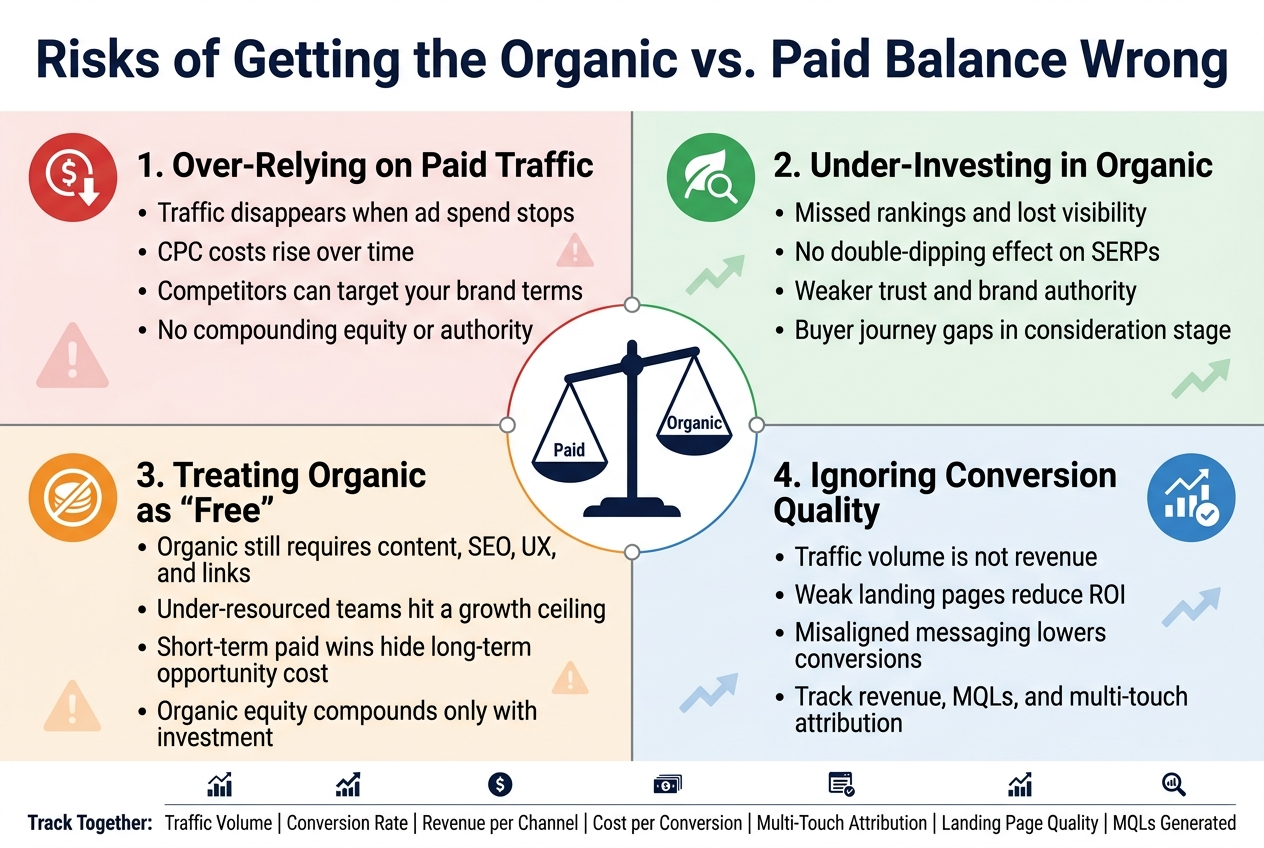
Risks of Getting the Organic vs. Paid Balance Wrong
Getting the balance between organic and paid traffic right is one of the most consequential decisions a digital marketing team will make. Tipping too far in either direction introduces compounding risks that quietly erode revenue, brand authority, and long-term growth potential. Most businesses discover these risks only after they’ve already felt their effects — when ad budgets are slashed and traffic collapses overnight, or when years pass without meaningful investment in SEO and the brand remains invisible beyond the reach of its ad spend.
Understanding these risks in concrete, operational terms is the foundation for building a more resilient digital marketing strategy. With that in mind, this section examines the specific dangers at each extreme: what happens when you over-rely on paid traffic, what you sacrifice by under-investing in organic, why treating organic as a cost-free channel stunts long-term growth, and how ignoring conversion quality undermines the revenue potential of both channels.
A. Dangers of Over-Relying on Paid Traffic
When Paid Traffic Becomes a Crutch
Paid traffic delivers results with remarkable speed. A well-configured pay-per-click campaign on Google can start generating clicks within hours of launch, and social media ads can place your brand in front of highly segmented audiences almost immediately. This immediacy is genuinely valuable — but it comes with a structural dependency that many businesses fail to account for until it’s too late.
When a business directs the majority of its digital marketing budget toward paid channels and allows its organic search presence to remain underdeveloped, it creates a fragile traffic architecture. Every visitor that arrives at the site is effectively rented. The moment the advertising budget is reduced, paused, or reallocated, that traffic vanishes. There is no equity being built. No residual value accumulates from months or years of paid campaigns in the way that a well-optimized piece of content or a strong backlink profile continues to generate organic visits long after the initial investment.
This is fundamentally different from what happens with organic traffic. High-ranking organic results, as research from Backlinko has shown, receive significantly more clicks over time, and those rankings, once earned, do not expire the instant a budget line is removed from a spreadsheet. Organic search equity compounds. Paid traffic, by contrast, operates on a transactional model — you pay, you receive traffic; you stop paying, you stop receiving traffic.
For businesses that have built their entire customer acquisition model on paid advertising without simultaneously cultivating their organic presence, this creates a perpetual, escalating cost structure with no exit ramp.
The Escalating Cost Problem
One of the most well-documented risks of over-relying on paid traffic is cost inflation. Digital advertising costs, particularly cost-per-click (CPC) on Google and Meta platforms, have increased significantly over time. When seoClarity evaluated its own branded paid search campaigns, the decision to experiment with pausing them was driven explicitly by this concern — as Google’s CPCs had increased significantly, the team needed to evaluate how much incremental traffic they were actually generating relative to what they were paying.
This is not an isolated experience. Across industries, as more advertisers compete for the same keywords and audience segments, CPCs rise. A business that was efficiently acquiring customers through paid search three years ago may now be paying substantially more per click for the same keyword positions, with no corresponding improvement in conversion rates. The return on investment naturally deteriorates.
For businesses that have not built organic search presence alongside their paid campaigns, there is no alternative traffic channel to absorb demand when CPCs become prohibitive. They are effectively locked in — forced to continue spending at increasing rates because the organic infrastructure that could supplement or partially replace paid acquisition was never developed.
Competitive Vulnerability and the Brand Term Problem
Over-reliance on paid traffic also creates a specific and particularly damaging competitive vulnerability: competitors can target your brand terms.
This was demonstrated clearly in a real-world test documented by seoClarity involving a leading automotive brand. When that brand paused its paid search campaigns for brand terms — even temporarily — competitors moved quickly to place ads against those same brand keywords. The result was a noticeable drop in overall traffic, not just paid traffic, because organic results were displaced by competitors’ paid ads appearing prominently above them.
This scenario illustrates a critical and often underappreciated dynamic: even when a business ranks organically for its own brand name, that organic position can be undermined by paid competition occupying the space above it on the search engine results page. When your business is over-reliant on paid traffic and makes budget cuts, competitors don’t remain passive. They seize the opportunity.
The automotive brand’s experience reinforced what digital marketers have long observed: continued investment in branded paid search is often necessary to protect market share and maintain visibility, regardless of how strong organic rankings might be. But this only holds when a business has already built enough organic authority to make it worthwhile to defend. Businesses that have neglected organic development are even more exposed — they lack the safety net of strong organic rankings to catch them when paid campaigns are paused or budgets are reallocated.
The Absence of Cumulative Learning and Authority
Paid traffic campaigns generate valuable data about user behavior, keyword performance, and audience response. But that data primarily benefits future paid campaigns. It does not, in itself, build the domain authority, backlink profile, content depth, or topical expertise that search engines reward with organic rankings.
When a business focuses exclusively or predominantly on paid traffic over an extended period, it accumulates spend without accumulating the foundational assets that make organic search viable. Competitors who have been investing in SEO during that same period are building compounding advantages: more content, more inbound links, more topical authority, and stronger signals of credibility to search engines. The longer the gap persists, the harder it becomes to close.
The businesses most exposed to this risk are those in competitive sectors with long buying cycles. In these environments, organic content — informational blog posts, product comparisons, detailed guides, and testimonials — plays a decisive role during the consideration and decision stages of the buyer’s journey. Without that organic content infrastructure, a business is effectively absent from the conversations that happen before a customer is ready to click a paid ad and convert.
Budget Volatility and Organizational Risk
There is also an organizational risk dimension to over-reliance on paid traffic that is rarely discussed but frequently experienced. Marketing budgets are not static. Economic downturns, shifts in company strategy, leadership changes, or investor pressure can all result in sudden reductions to paid advertising spend.
For a business that has built its entire digital traffic strategy around paid channels, a budget cut is not merely an operational inconvenience — it is an existential traffic risk. If paid ads represent 80% or 90% of website traffic, and that budget is halved, the business loses half of its digital audience almost immediately.
Organizations that have invested steadily in organic traffic alongside paid campaigns have a buffer. Organic traffic continues flowing even when budgets contract. It provides stability and resilience that purely paid-dependent traffic strategies fundamentally cannot offer, regardless of how sophisticated or well-optimized those paid campaigns might be.
B. Costs of Under-Investing in Organic Traffic
The Invisible Cost of Organic Neglect
Under-investing in organic traffic carries costs that are less immediate and therefore easier to overlook than the costs of overspending on paid ads. The damage accumulates gradually — missed rankings, lost brand authority, diminished trust — until the cumulative deficit becomes large enough to affect revenue in ways that are difficult to quickly reverse.
The organic search channel operates differently from every other traffic channel in one important respect: the return on organic investment is non-linear and time-delayed. Content published today may not achieve strong rankings for months. Backlinks earned through sustained outreach compound authority over years. Under-investing in organic traffic does not deliver an immediate visible consequence. It delivers a future revenue shortfall — an opportunity cost that becomes apparent only in retrospect when a competitor is capturing the search demand that your brand could have owned.
Research consistently shows that pages appearing on the first page of Google’s search results receive dramatically more clicks than those on subsequent pages. Businesses that under-invest in organic SEO are systematically absent from those first-page positions for the queries their potential customers are making. Every day a competitor occupies a ranking your business could have earned represents traffic that will never visit your site, leads that will never enter your pipeline, and revenue that will never materialize.
Forfeiting the “Double-Dipping” Advantage
One of the most compelling findings in the research on paid and organic traffic interaction is what is often described as the “double-dipping” effect: when a brand appears in both the paid and organic sections of the search engine results page simultaneously, there is a notable increase in clicks and a higher likelihood of conversion compared to appearing in just one section.
This effect occurs because users who see a brand represented in multiple positions on the same SERP — through both a paid ad at the top and an organic result below — perceive that brand as more credible, more authoritative, and more relevant to their search intent. The dual presence reinforces trust in a way that neither channel can achieve on its own.
Businesses that under-invest in organic traffic forfeit this advantage entirely. Even when their paid ads are running effectively and appearing prominently, the absence of organic results for the same queries means they are capturing a fraction of the potential clicks and trust signals that a combined presence would generate. They are leaving a measurable portion of search demand on the table — not because they aren’t spending, but because they aren’t building.
This is one of the most tangible and quantifiable costs of organic under-investment that often goes unrecognized. It’s not just that you’re missing organic traffic; you’re also reducing the effectiveness of the paid traffic you’re already paying for.
Brand Recognition and Trust Deficits
The relationship between organic visibility and brand trust is well established in the research on digital marketing behavior. Studies have consistently demonstrated that users tend to trust brands more when they appear in both paid and organic search results. The organic presence, in particular, functions as a form of third-party validation — it signals to users that the search engine itself considers this brand relevant and authoritative for the given query, independent of advertising spend.
When a business under-invests in organic traffic, it loses this trust signal. Its digital presence is perceived as existing only because it is paying to appear, rather than because it has genuinely earned authority in its domain. For users who are in the consideration or decision stage of the buying process — actively evaluating competitors and weighing credibility signals — this distinction matters enormously.
A comprehensive online presence that spans both paid and organic results fosters trust and confidence among users in ways that paid-only visibility cannot replicate. A strong brand presence across multiple touchpoints on the search results page reinforces the brand’s authority in its industry. Businesses that neglect organic investment are operating with a truncated trust-building capability, relying entirely on the persuasive power of paid ad copy without the supporting credibility that organic rankings provide.
The Content Gap and Buyer Journey Coverage Failures
Under-investing in organic traffic typically means under-investing in content — and under-investing in content creates structural gaps in buyer journey coverage that paid advertising alone cannot bridge.
The buyer’s journey moves through three broad stages: awareness, consideration, and decision. Paid advertising is most effective at the awareness stage, where it captures attention, and at the decision stage, where remarketing campaigns and promotional offers can tip wavering buyers toward conversion. But in the consideration stage — when buyers are actively researching, comparing, reading reviews, and educating themselves before making a decision — organic content is the dominant channel.
Informative blog posts, product comparisons, how-to guides, testimonials, and detailed resource pages that rank organically are what capture buyers during the consideration phase. This is the stage where brand authority is cemented or lost. A business without organic content assets is largely absent from this conversation. Paid ads can interrupt, but they cannot educate in the sustained, trust-building way that a comprehensive library of high-quality organic content can.
Research highlights that organic content plays a pivotal role in the consideration stage, establishing the brand as an industry authority through the delivery of genuinely useful information. When businesses under-invest in organic, they are not just missing clicks — they are ceding the consideration phase of the buyer journey to competitors who have taken the time to build those content assets.
Over extended timeframes, this creates compounding brand disadvantages. Competitors that rank for informational queries in your sector become the go-to sources of expertise and information for your potential customers. When those customers finally reach the decision stage, they are already more familiar with, more trusting of, and more predisposed toward the brands they encountered while researching — not the brand they only ever saw as a paid ad.
The Compound Interest of Forgone Organic Equity
Perhaps the most significant cost of under-investing in organic traffic is the forgone compound interest of organic equity. Strong organic rankings, once established, continue generating traffic without proportional ongoing spend. A well-optimized article that ranks on the first page of Google for a high-volume keyword can drive thousands of clicks per month for years, providing a continuous return on a one-time (or periodically updated) investment.
Businesses that consistently under-invest in organic traffic during their growth years lose access to this compounding dynamic. They enter competitive maturity with a thinner content library, fewer authoritative backlinks, and weaker domain authority than their more SEO-conscious competitors. The longer this under-investment persists, the larger the gap becomes — and the more expensive and time-consuming it becomes to close.
This is the silent long-term cost of organic neglect: not just the traffic you’re missing today, but the traffic asset base you’re failing to accumulate for tomorrow. Every quarter of under-investment in SEO and content is a quarter where competitors are adding to their advantage and your relative position is weakening, even if your paid campaigns are delivering acceptable short-term results in isolation.
C. Why Treating Organic as Free Stalls Long-Term Growth
The “Free Traffic” Misconception and Its Consequences
One of the most persistent and damaging misconceptions in digital marketing is the characterization of organic traffic as “free.” The term has a surface-level logic — you are not paying per click the way you do with paid search or display advertising. But describing organic traffic as free fundamentally misunderstands what it actually costs to earn and sustain, and this misunderstanding leads directly to the chronic under-resourcing of SEO efforts that stalls long-term growth.
Organic traffic is not free. It is the product of sustained investment in content creation, technical SEO, backlink development, user experience optimization, and ongoing monitoring and adjustment. It requires skilled professionals — writers, SEO strategists, technical developers, data analysts — and the cost of their work is real and significant. The difference between paid and organic traffic is not the presence or absence of cost; it is the structure and timing of the cost relative to the return.
When businesses internally classify organic traffic as “free” in their budget discussions and strategic planning, they consistently under-allocate resources to the activities required to generate it. Content production gets underfunded. SEO tooling and expertise go under-invested. Technical debt accumulates on the website. The team responsible for organic performance is smaller and less resourced than the team managing paid campaigns, even though the long-term return on organic investment often exceeds that of paid channels when measured over multi-year timeframes.
This misclassification is not a minor semantic issue. It shapes budget allocation decisions, hiring priorities, project timelines, and strategic focus in ways that systematically disadvantage organic channel development and stall the long-term growth that a properly resourced organic strategy would deliver.
The Resource Requirements of Sustainable Organic Performance
To understand why treating organic as free stalls long-term growth, it helps to be precise about what earning and maintaining strong organic rankings actually requires.
First, content quality and relevance are foundational. Search engines, including Google, prioritize content that aligns with user queries and offers valuable insights. Content that is thin, generic, or misaligned with user intent does not rank. Producing content that meets the quality bar required for competitive organic rankings demands skilled writers with subject matter expertise, a well-researched content strategy, ongoing editing and quality assurance, and regular updates as search intent and competitive landscapes evolve.
Second, the user experience of the pages where organic traffic lands must be genuinely good. Page load times, mobile responsiveness, navigation clarity, content structure, and the seamlessness of the path from arrival to conversion all influence both search engine rankings and the value extracted from organic traffic once it arrives. These are technical investments that require developer resources and ongoing attention.
Third, earning the backlinks and domain authority that support competitive rankings requires sustained outreach, relationship building, and the creation of content valuable enough that other sites want to link to it. This is not a one-time activity — it is ongoing work that must continue as competitors also pursue their own link-building efforts.
None of these activities happen at zero cost. Businesses that treat organic traffic as free implicitly treat all of these investments as optional or secondary, which means they are never consistently resourced at the level required to generate the compounding organic growth that is actually available to them.
Under-Resourced Organic Programs and Their Growth Ceiling
When organic efforts are chronically under-resourced because they are mentally categorized as “free,” the organic channel consistently underperforms its potential. Content production is intermittent and insufficient in volume to build topical authority. Technical SEO issues accumulate because there is no dedicated resource to identify and resolve them. The backlink profile grows slowly because outreach is deprioritized in favor of the paid campaigns that consume a disproportionate share of both budget and team attention.
The growth ceiling this creates is real and measurable. Organic rankings plateau or decline. The business remains dependent on paid traffic for the majority of its digital acquisition. And because organic has never been given the resource investment needed to demonstrate its full potential, it is perceived internally as less effective than paid — which further justifies continued under-investment in a self-reinforcing cycle.
This pattern is particularly damaging for businesses with strong product-market fit and genuine potential for organic search demand. They are leaving a large portion of available search traffic uncaptured because organic has been effectively treated as a bonus outcome rather than a deliberately managed growth channel.
The Opportunity Cost of Misallocated Investment
When resources that could be directed toward building long-term organic equity are instead concentrated entirely in paid campaigns, the opportunity cost compounds over time in a way that becomes increasingly difficult to reverse.
Consider the investment required to rank organically for a competitive industry keyword. It might take six to twelve months of consistent content creation, technical optimization, and link building before a page achieves first-page rankings. During those months, the organic investment feels expensive because it is generating limited returns. Paid campaigns, by contrast, are generating immediate returns, which makes them feel more efficient.
But once those organic rankings are established, the return continues without proportional additional spending. The content keeps ranking. The traffic keeps flowing. The investment made six to twelve months ago continues generating value for years afterward. Paid traffic, by contrast, requires continuous reinvestment to maintain — every time the budget pauses, the traffic stops.
Businesses that under-resource organic and over-invest in paid because organic “seems slower” are in effect choosing to continuously rent traffic rather than invest in owning it. Over a five- or ten-year horizon, this strategic choice compounds into a significant competitive disadvantage.
The Compounding Nature of Organic Equity
The strongest argument against treating organic traffic as free — and therefore against the under-investment this misclassification produces — is the compounding nature of organic equity when it is properly funded.
High-quality content assets earn backlinks over time as they are discovered, shared, and referenced by other sites. Those backlinks increase domain authority, which improves the rankings of other pages on the same domain, which generates more traffic and more backlinks. Technical improvements to site speed and mobile experience improve rankings across the entire site simultaneously, multiplying the return on each individual investment. Topical authority, built through a consistent body of high-quality content on related subjects, signals expertise to search engines in ways that lift rankings for new content more quickly.
All of these dynamics operate as a compounding flywheel. The more you invest in organic, the more the prior investments become worth. But this flywheel only activates when organic is resourced consistently and at a sufficient level of investment. Treating it as free — as a channel that should somehow produce returns without real resource allocation — prevents the flywheel from ever gaining the momentum it needs to deliver the compounding growth that makes organic so valuable over the long term.
When businesses finally recognize this and begin properly investing in organic SEO, they often find that the returns accelerate more quickly than they expected, precisely because the compounding dynamics have been building slowly beneath the surface, waiting for sufficient resource to activate them. But the years during which organic was treated as free represent permanently forgone growth that cannot be recovered — only compensated for by accelerated future investment.
D. How Ignoring Conversion Quality Hurts Revenue
Traffic Volume Is Not Revenue
Perhaps the most fundamental error that businesses make when evaluating their organic vs. paid traffic strategy is conflating traffic volume with revenue. It is entirely possible to drive large volumes of traffic from both organic and paid sources while simultaneously generating disappointing conversion rates and inadequate revenue outcomes. The quantity of traffic tells you very little about its quality — and it is traffic quality, measured through conversion rates and revenue outcomes, that actually determines whether your digital marketing investment is delivering business value.
Ignoring conversion quality creates a distorted picture of channel performance. A paid campaign that drives 10,000 monthly visits with a 4% conversion rate is generating 400 conversions. An organic strategy that drives 50,000 monthly visits with a 0.5% conversion rate is generating 250 conversions — despite representing five times the traffic volume. If you are evaluating these channels primarily by traffic volume, you would conclude that organic is performing better. If you are evaluating by revenue, the picture looks very different.
This kind of misanalysis is common and leads to genuinely harmful strategic decisions: over-investing in high-volume, low-quality traffic sources while under-investing in lower-volume, higher-quality channels. The result is a marketing strategy optimized for impressive traffic dashboards rather than actual business outcomes.
The Role of Conversion Rate Optimization Across Both Channels
Conversion rate optimization (CRO) is not a separate discipline from traffic strategy — it is an integral component of the ROI calculation for both organic and paid channels. Understanding the correlation between paid and organic traffic extends beyond mere visibility; CRO directly influences the return on investment for both paid and organic channels.
When CRO is ignored or under-resourced, even well-performing traffic sources deliver disappointing revenue outcomes. A paid campaign can drive highly targeted, purchase-intent traffic to a landing page that has poor copy, confusing navigation, slow load times, or a checkout process with unnecessary friction — and convert at a fraction of its potential rate. An organic content strategy can draw large audiences of engaged readers who then fail to convert because the pages lack clear calls to action, appropriate next steps, or a seamless pathway toward purchase.
Research on this topic emphasizes that a seamless user experience, compelling calls to action, and consistent messaging across paid and organic touchpoints all contribute to higher conversion rates. When any of these elements is missing or misaligned, the conversion potential of traffic from both channels is systematically undermined — and the revenue shortfall is directly attributable to the neglect of conversion quality.
Misaligned Messaging Between Paid Ads and Organic Content
One of the most common and damaging conversion quality failures in businesses that do not think carefully about the intersection of paid and organic is misalignment in messaging. When the promise made in a paid advertisement does not match the experience delivered by the landing page the user arrives at, conversion rates suffer dramatically.
Paid advertising campaigns that echo the same messaging and value proposition as organic content contribute to a cohesive user experience. This alignment strengthens the correlation between paid and organic efforts, fostering a seamless journey for users from initial discovery through conversion.
Conversely, when messaging is inconsistent — when a paid ad promises one thing and the landing page delivers something different, or when organic content sets expectations that the product pages or service descriptions fail to meet — users experience cognitive dissonance. Trust erodes. The likelihood of conversion drops. And because this drop happens at the conversion stage rather than the traffic acquisition stage, it can persist undetected for extended periods while the business continues spending on traffic generation that delivers diminishing revenue returns.
This is a risk that applies across both organic and paid channels simultaneously. If your paid ads and your organic content are not telling a consistent story with aligned messaging and a shared value proposition, you are generating traffic at significant expense that is then leaking revenue through a conversion experience that fails to deliver on the promises made during discovery.
Landing Page Quality and Its Revenue Implications
The quality of landing pages sits at the center of the conversion quality challenge for both organic and paid traffic. Research on maximizing the combined performance of paid and organic channels consistently identifies landing page optimization as a critical lever for improving conversion rates and revenue outcomes.
For paid campaigns, landing page quality is particularly acute because the cost of driving traffic to a poor-converting page is immediately visible in wasted ad spend. Every click that arrives at an ineffective landing page and fails to convert represents both the cost of that click and the forgone revenue from a customer who arrived with genuine purchase intent but was not converted.
For organic traffic, the stakes are different but the revenue implication is equally significant. Organic landing pages — whether blog posts, product pages, category pages, or service descriptions — need to not only attract traffic by ranking well but also convert that traffic into leads, trials, purchases, or whatever the desired business outcome might be. A piece of content that ranks on the first page of Google and drives 5,000 monthly visitors but converts at 0.2% is generating 10 conversions per month. The same content with a conversion rate of 2% would generate 100 conversions — a tenfold improvement in revenue outcome from the same traffic, achieved entirely through better conversion optimization.
Optimizing landing pages for both paid and organic traffic provides a seamless user experience that ensures the investment in both channels yields the desired results, ultimately maximizing the ROI. Without this optimization focus, businesses are systematically extracting a fraction of the revenue potential available to them from their traffic, regardless of how well their SEO and paid campaigns are performing as traffic-generation mechanisms.
The A/B Testing Imperative
One of the most powerful applications of the relationship between paid and organic traffic that most businesses under-utilize is using paid campaigns as a rapid testing ground for the messaging, positioning, and creative approaches that then inform organic content optimization.
Paid advertising allows marketers to experiment with various keywords, ad copies, and landing pages to assess their performance quickly and with statistically significant data volumes. The insights gained from paid campaigns can inform organic SEO strategies, helping to identify high-performing keywords and optimize on-page content accordingly. By analyzing click-through rates, conversion rates, and other metrics from paid campaigns, teams can refine their organic content targeting and tailor landing pages to align more closely with user intent and preferences.
This iterative testing and learning process is one of the most concrete mechanisms through which paid and organic channels can amplify each other’s performance. But businesses that ignore conversion quality miss this opportunity entirely. They may be running paid campaigns and producing organic content in parallel, but if they are not systematically analyzing conversion data and using it to improve both channels, they are leaving a significant revenue optimization opportunity unexploited.
Implementing A/B testing, analyzing user behavior, and optimizing landing pages based on insights from both paid and organic campaigns can lead to improved conversion rates. This holistic approach ensures that the investment in both paid and organic channels yields the desired results, ultimately maximizing the ROI. The businesses that build this iterative, data-driven optimization loop create a genuine competitive advantage that compounds over time, as each round of testing improves the conversion performance of both channels simultaneously.
Revenue Metrics vs. Traffic Metrics: The Attribution Gap
A particularly consequential form of ignoring conversion quality is the failure to track and attribute revenue accurately across both paid and organic channels. Many businesses evaluate their digital marketing performance primarily through traffic metrics — sessions, page views, impressions, and clicks — because these are easy to measure and readily available in analytics dashboards. Revenue attribution, particularly in customer journeys that involve multiple touchpoints across paid and organic channels, is more complex and requires more sophisticated measurement approaches.
This creates an attribution gap that systematically distorts the perceived value of different traffic channels. A user might first discover a brand through a paid search ad, return via organic search after reading a blog post, and then convert after clicking a remarketing ad. In a last-touch attribution model, the remarketing ad gets full credit for the conversion. The organic content visit, which played a crucial role in the consideration phase, receives no attribution.
Understanding attribution is essential for evaluating both paid and organic channels accurately. Attribution modelling involves assigning credit to various touchpoints along the customer journey, helping marketers understand which channels contribute most to conversions. In industries with longer sales cycles requiring multiple visits from various sources, this attribution complexity is particularly pronounced.
Multi-touch attribution models, which assign value to multiple touchpoints in the customer journey, provide a more nuanced and accurate view of how paid and organic channels are each contributing to revenue. Both paid and organic channels contribute at various stages, and understanding this interaction is crucial for a balanced marketing strategy that makes well-informed investment decisions.
Businesses that rely on simplistic attribution models or ignore conversion quality tracking entirely are making budget allocation decisions based on incomplete and distorted revenue data. They may be under-investing in organic channels that are contributing meaningfully to revenue in the consideration phase — but whose role is invisible in a last-touch attribution framework. Or they may be over-investing in paid campaigns that capture the credit for conversions that were actually driven by organic content earlier in the customer journey.
Traffic is just one piece of the puzzle in evaluating digital marketing performance. The evaluation must also include other important metrics like revenue or Marketing Qualified Leads (MQLs). Without tracking these downstream revenue metrics and integrating them with traffic data, it is impossible to accurately assess whether the current balance between organic and paid traffic is generating optimal business outcomes — or to identify where conversion quality issues are silently draining revenue from an otherwise functioning traffic strategy.
The CRO and ROI Connection Across Both Channels
Conversion rate optimization and return on investment are inextricably linked across both paid and organic channels in ways that most businesses do not fully account for in their strategic planning.
For paid traffic, the ROI calculation is relatively straightforward: ad spend divided by revenue generated. But this calculation is highly sensitive to conversion rate. A doubling of conversion rate effectively doubles the ROI of the same ad spend, without requiring any increase in budget. The implication is that investment in CRO often delivers higher ROI improvement per dollar than investment in additional ad spend — particularly when campaigns are already well-optimized for targeting and bidding.
For organic traffic, the ROI calculation is less immediate but equally sensitive to conversion quality. The investment in content creation and SEO is largely fixed in the short term. The revenue generated from that investment is determined by traffic volume multiplied by conversion rate multiplied by average transaction value. Improving conversion rate on organic landing pages increases revenue from existing organic traffic without requiring additional SEO investment — making CRO one of the highest-leverage activities available to teams seeking to improve the return on their organic investment.
Yet businesses that ignore conversion quality are systematically failing to pursue this high-leverage opportunity in either channel. They continue spending on traffic acquisition while the conversion experience leaks revenue through poor landing page design, misaligned messaging, inadequate calls to action, and insufficient attention to the user experience that bridges the gap between a visit and a conversion.
A seamless user experience, compelling calls to action, and consistent messaging across paid and organic touchpoints together contribute to higher conversion rates. This is not a peripheral concern or a nice-to-have optimization — it is the mechanism through which the investment in traffic, across both channels, translates into actual business revenue. Ignoring conversion quality in either channel means accepting a systematically lower return on every dollar spent on digital marketing, regardless of how sophisticated the targeting, bidding, or SEO strategies may be.
Why Conversion Quality Must Be Tracked Alongside Traffic Data
Practically speaking, the risk of ignoring conversion quality is most acute when traffic data and revenue data are tracked in separate systems that are rarely analyzed together. Marketing teams optimize for the metrics they measure, and when traffic metrics are the primary dashboard, conversion quality naturally receives less attention than it deserves.
The solution is to integrate analytics systems so that traffic data — including the distinction between paid and organic sources — is always viewed alongside conversion and revenue data. When you can see simultaneously that organic traffic is growing while organic conversion rates are declining, you have a signal that there is a landing page or content quality issue that deserves attention. When you can see that a paid campaign is driving high traffic but below-average conversion rates, you have a signal that the targeting, landing page, or offer needs refinement.
Integrated analytics that combine traffic source data with conversion and revenue outcomes make it possible to assess the true ROI of both organic and paid investments and to identify the conversion quality failures that are silently reducing revenue from each channel. Without this integration, businesses are navigating their most important digital marketing decisions with incomplete and misleading information — making it virtually certain that they will get the organic vs. paid balance wrong, not through strategic error, but through measurement failure.
| Metric Category | What It Measures | Why It Matters |
|---|---|---|
| Traffic Volume | Sessions, clicks, impressions per channel | Indicates reach; does not indicate quality or revenue |
| Conversion Rate | % of visitors completing desired action | Directly determines revenue per unit of traffic |
| Revenue per Channel | Actual revenue attributed to paid vs. organic | True measure of channel ROI |
| Cost per Conversion | Ad spend or SEO investment divided by conversions | Enables apples-to-apples ROI comparison across channels |
| Multi-Touch Attribution | Revenue credit distributed across all touchpoints in journey | Accurately reflects channel contribution in complex journeys |
| Landing Page Quality Metrics | Bounce rate, time on page, scroll depth | Diagnostic indicators of conversion experience quality |
| MQLs Generated | Marketing qualified leads by traffic source | Revenue-proxy metric for B2B and longer sales cycle contexts |
Tracking all of these dimensions together, rather than focusing exclusively on traffic volume, is what separates businesses that genuinely understand the revenue performance of their organic and paid channels from those that are optimizing for the appearance of growth rather than its substance.
The risks examined throughout this section — over-reliance on paid traffic, chronic under-investment in organic, the misclassification of organic as free, and the neglect of conversion quality — are not independent failures. They are interconnected manifestations of a strategy that has lost sight of the fundamental goal: building a digital marketing engine that generates sustainable revenue growth, not just traffic volume. Each risk amplifies the others, and each is most effectively addressed not in isolation but through a balanced, integrated approach to managing organic and paid traffic together — which is precisely what the next section explores.
Building a Sustainable Growth Strategy With Both Channels
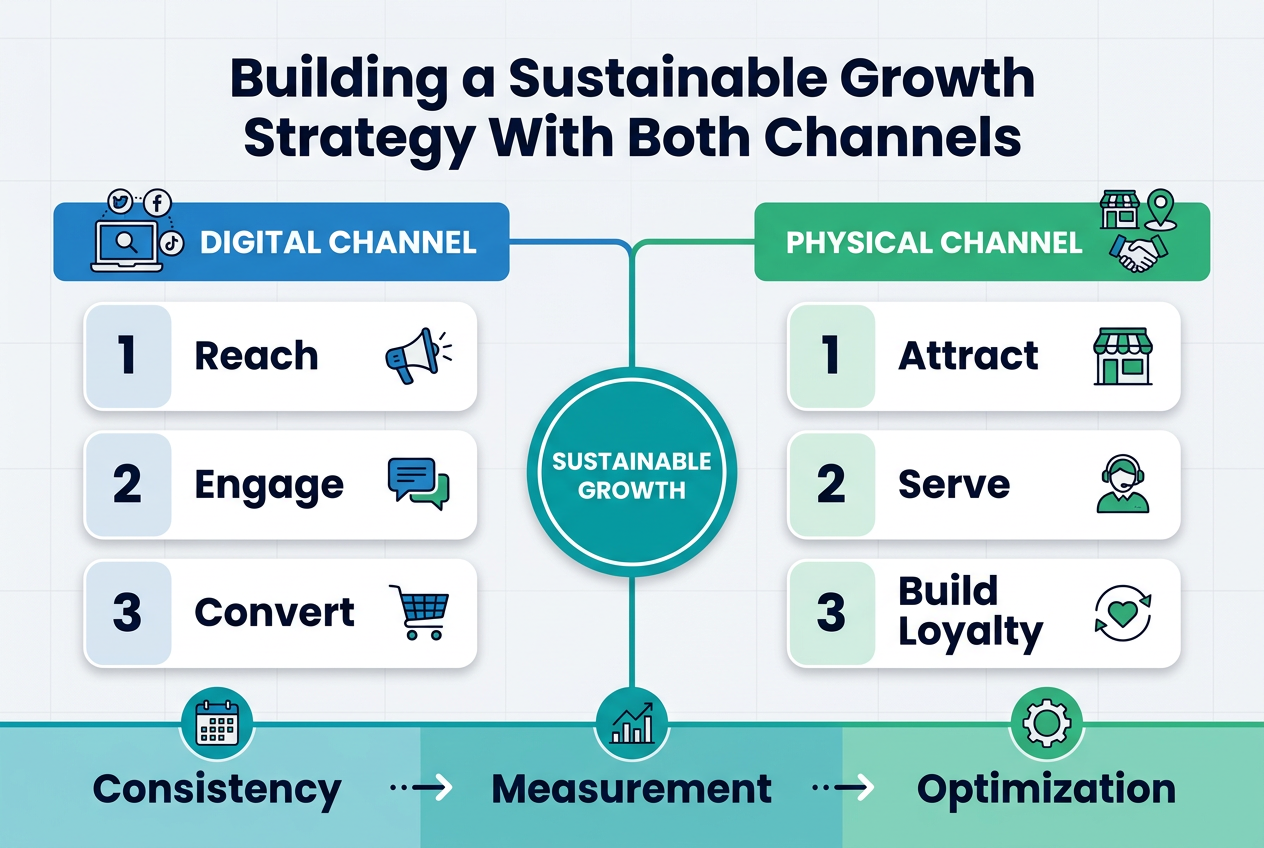
Why the Strongest Businesses Combine Organic and Paid
The most resilient businesses treat organic and paid not as competing channels but as complementary forces. Paid ads deliver immediate visibility and fast results, while organic builds long-term trust and sustainable website traffic growth. Without organic presence, paid ads can appear untrustworthy; without paid support, organic growth can stall for months. Together, they create a system that reaches new audiences quickly while nurturing them into loyal customers — covering every stage of the buyer’s journey from awareness through to conversion.
How Paid Data Can Strengthen Your Organic Content Strategy
One of the most underutilized advantages in balancing SEO and paid advertising is using paid campaign data to sharpen your organic strategy. When a headline, keyword, or offer performs exceptionally well in a PPC campaign, that insight is a signal — not just for your ads, but for your blog posts, landing pages, and social content too. High click-through rates on paid keywords reveal what language resonates with your audience, allowing you to weave those terms naturally into your organic content for stronger rankings. This feedback loop between paid traffic and SEO makes both channels more effective over time.
Which Business Types Benefit Most From an Organic-First Approach
Not every business should split its budget evenly from day one. Startups and businesses with tighter budgets typically benefit most from an organic-first approach — building credibility and compounding traffic before layering in paid spend. Content-driven businesses, such as SaaS companies, publishers, and B2B service providers like HubSpot, lean heavily on SEO and blogging to attract visitors and demonstrate expertise, then use paid ads selectively to amplify proven content or accelerate lead generation. Established brands in highly competitive industries, however, often need paid support running simultaneously to maintain visibility while organic authority develops.
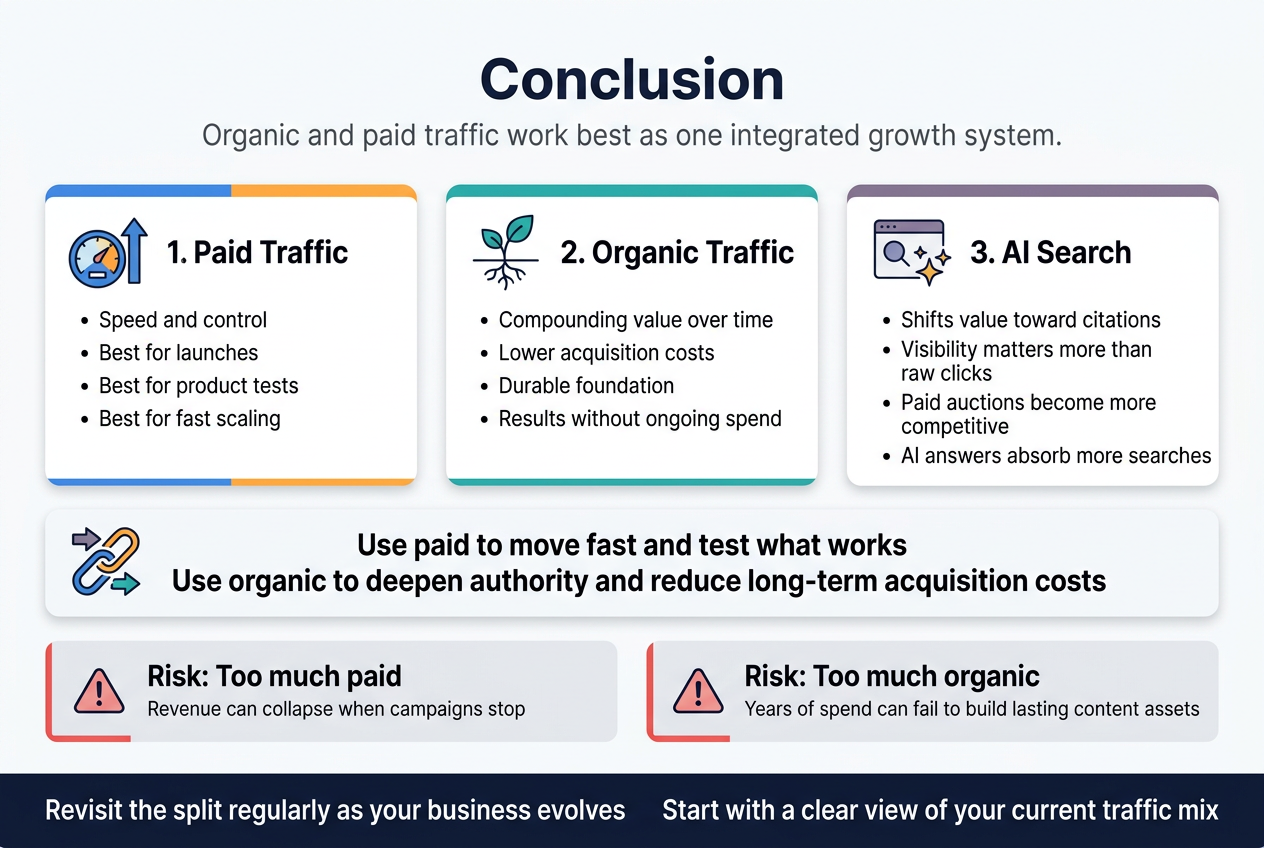
Organic and paid traffic each play a distinct role in building sustainable growth, and the right balance between them depends on your timeline, budget, and business stage. Paid traffic delivers speed and control, making it the right tool for launches, product tests, and fast scaling. Organic traffic builds compounding value over time, lowering acquisition costs and creating a durable foundation that keeps generating results without ongoing spend. AI search is adding another layer to this equation, shifting organic value toward citations and visibility rather than raw clicks, while making paid auctions more competitive as AI answers absorb a larger share of searches.
The businesses that grow most consistently treat organic and paid traffic as one integrated system rather than competing priorities. Getting the balance wrong in either direction creates real risk, from revenue that collapses when a paid campaign stops to years of spend that never builds lasting content assets. Use paid traffic to move fast and test what works, use organic to deepen authority and reduce long-term acquisition costs, and revisit the split regularly as your business evolves. A clear view of where your current traffic mix stands is the best starting point for building a strategy that holds up over time.